
Baric’s 2000 Method Split Coronavirus Genomes Into 6 Pieces Joined by 5 Restriction Sites for ‘Ease of Genetic Manipulation’—SARS-CoV-2 Is Likewise Split Into 6 Pieces by 5 Restriction Sites
SARS-CoV-2 carries the six-piece, five-restriction-site structure Ralph Baric identified nearly three decades ago as necessary for engineering coronavirus genomes.

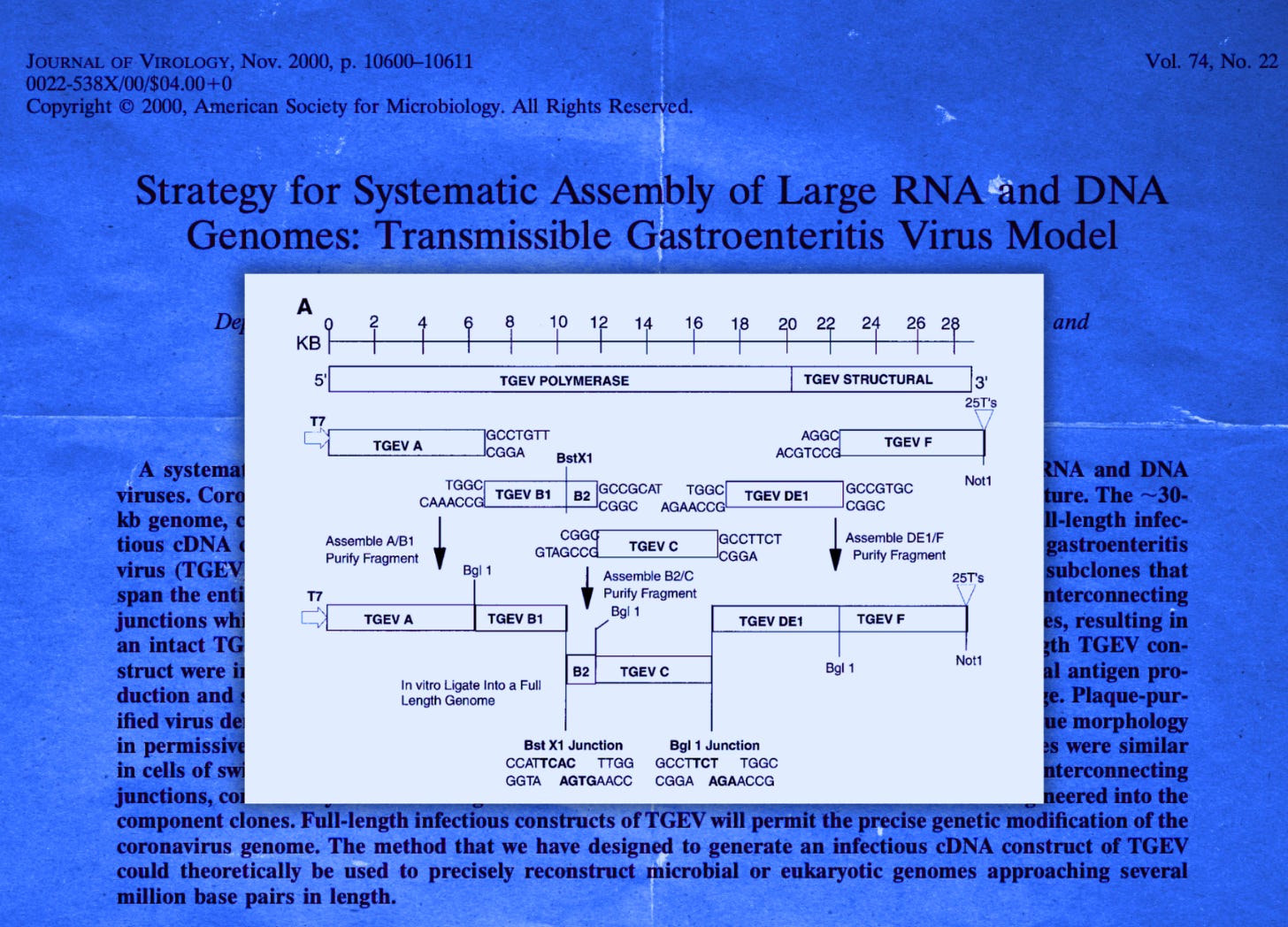
In a November 2000 Journal of Virology paper, coronavirologist Ralph Baric published a method for making coronavirus genetic sequences more easily manipulable in the lab.
The ~30 kb size of coronavirus genomes made them too large and unstable to handle as a single piece of complementary DNA (cDNA).
Baric’s solution was to break the genome into six pieces separated by five restriction sites.
According to the 2000 paper:
“A systematic method was developed to assemble functional full-length genomes of large RNA and DNA viruses. Coronaviruses contain the largest single-stranded positive-polarity RNA genome in nature. The approximately 30-kb genome, coupled with regions of genomic instability, has hindered the development of a full-length infectious cDNA construct. We have assembled a full-length infectious construct of transmissible gastroenteritis virus (TGEV), an important pathogen in swine. Using a novel approach, six adjoining cDNA subclones that span the entire TGEV genome were isolated. Each clone was engineered with unique flanking interconnecting junctions which determine a precise systematic assembly with only the adjacent cDNA subclones, resulting in an intact TGEV cDNA construct of approximately 28.5 kb in length. … The recombinant viruses were sequenced across the unique interconnecting junctions, conclusively demonstrating the marker mutations and restriction sites that were engineered into the component clones. Full-length infectious constructs of TGEV will permit the precise genetic modification of the coronavirus genome. The method that we have designed to generate an infectious cDNA construct of TGEV could theoretically be used to precisely reconstruct microbial or eukaryotic genomes approaching several million base pairs in length.”
The point was to overcome the size problem that “hampered the ability to perform precise manipulations and reverse genetics in members of the Coronaviridae.”

He patented the method in 2005.

In a 2017 Methods in Molecular Biology publication, Baric explained that breaking up the coronavirus genome in this way made for “increased stability and ease of genetic manipulation and amplification.”
In plain language, before the COVID-19 pandemic, a leading coronavirologist said that to make a coronavirus sequence more manipulable for laboratory engineering, it needs to be split into six sections by five restriction sites.
Follow us on Instagram @realjonfleetwood & Twitter/X @JonMFleetwood.
If you value this reporting, consider upgrading to a paid subscription.
For advertising & sponsorship opportunities, contact us by clicking below.
2019’s SARS-CoV-2 Contains Six Sections Separated by Five Restriction Sites
Now look at the genetic sequence of the COVID-19 pathogen SARS-CoV-2.
The original SARS-CoV-2 reference sequence—Wuhan-Hu-1—contains five BsaI/BsmBI restriction sites.
Those five sites divide the approximately 30,000-nucleotide genome into six fragments.

SARS-CoV-2 therefore carries precisely the attributes Baric identified as necessary to render a coronavirus sequence engineerable and open to precise genetic manipulation.
The full laboratory history of how that original sequence was said to be produced after the pandemic began has never been released, raising provenance questions about where the sequence itself came from.
What has been released is Baric’s own description of the features required for engineering—and the fact that the pandemic virus sequence matches them.
Bruttel Concludes COVID-19 Pathogen ‘More Likely a Product of Synthetic Genome Assembly Than Natural Evolution’
In their 2023 paper Endonuclease fingerprint indicates a synthetic origin of SARS-CoV-2, Bruttel et al. assessed “the likelihood of observing such a pattern in coronaviruses with no history of bioengineering.”
They found that SARS-CoV-2 “contains a peculiar pattern of unique restriction endonuclease recognition sites allowing efficient dis- and re-assembly of the viral genome characteristic of synthetic viruses.”
The COVID-19 pathogen is “an anomaly, more likely a product of synthetic genome assembly than natural evolution. The restriction map of SARS-CoV-2 is consistent with many previously reported synthetic coronavirus genomes, meets all the criteria required for an efficient reverse genetic system, differs from closest relatives by a significantly higher rate of synonymous mutations in these synthetic-looking recognition sites, and has a synthetic fingerprint unlikely to have evolved from its close relatives. We report a high likelihood that SARS- CoV-2 may have originated as an infectious clone assembled in vitro.”
In their lay summary, Bruttel et al explain:
“To construct synthetic variants of natural coronaviruses in the lab, researchers often use a method called in vitro genome assembly. This method utilizes special enzymes called restriction enzymes to generate DNA building blocks that then can be ‘stitched’ together in the correct order of the viral genome. To make a virus in the lab, researchers usually engineer the viral genome to add and remove stitching sites, called restriction sites. The ways researchers modify these sites can serve as fingerprints of in vitro genome assembly.”
“We found that SARS-CoV has the restriction site fingerprint that is typical for synthetic viruses. The synthetic fingerprint of SARS-CoV-2 is anomalous in wild coronaviruses, and common in lab-assembled viruses. The type of mutations (synonymous or silent mutations) that differentiate the restriction sites in SARS-CoV-2 are characteristic of engineering, and the concentration of these silent mutations in the restriction sites is extremely unlikely to have arisen by random evolution. Both the restriction site fingerprint and the pattern of mutations generating them are extremely unlikely in wild coronaviruses and nearly universal in synthetic viruses. Our findings strongly suggest a synthetic origin of SARS-CoV2.”

Dr. Quay: ‘Probability That Such a Pattern Arose Naturally Is Less Than One In a Billion’
In March 2025, Dr. Steven Quay, an MD, PhD, and CEO of a clinical‑stage biopharmaceutical company, performed a similar analysis of the SARS-CoV-2 restriction sites.
Quay’s study identified “a highly atypical restriction site architecture in SARS-CoV-2. Unlike natural sarbecoviruses, which show randomly distributed restriction sites, SARS-CoV-2 exhibits segregated site placement and a statistically improbable depletion of restriction sites, features strongly associated with laboratory-engineered viruses.”
“The probability that such a pattern arose naturally is less than one in a billion, a finding that directly aligns with known synthetic virology techniques. …”
“These findings suggest that SARS-CoV-2’s genomic architecture is more consistent with an engineered virus than one shaped by natural selection, warranting further investigation into the laboratory-origin hypothesis.”
Bottom Line
Ralph Baric publicly described a strategy for making large coronavirus genomes easier to manipulate in the laboratory by dividing them into six fragments joined through five engineered restriction-site junctions.
He later explained that this modular design improved the stability of coronavirus clones and facilitated precise genetic manipulation.
The published Wuhan-Hu-1 SARS-CoV-2 reference genome—whose complete provenance has never been made public—likewise contains five BsaI/BsmBI restriction sites that divide the genome into six fragments.
Follow us on Instagram @realjonfleetwood & Twitter/X @JonMFleetwood.
If you value this reporting, consider upgrading to a paid subscription.
For advertising & sponsorship opportunities, contact us by clicking below.


is anyone else feeling ptsd coming on reading this;)) I can’t count how many times that I was put in FB jail for sharing these kinds of papers. So progress I suppose.
In the end this will be our undoing. Just because you can doesn’t mean you should. C-19 showed us that accidents do happen no matter what bio-lab your in, and the consequences unfathomable. There is no excuse or purpose in my mind that warrants this level of risk to humanity. They have created even more deadly forms of genome manipulated so called viruses; they are just sitting on a shelf waiting.——-They are not natural they are created and edited for weaponization. Nothing good can come of this impulse to play God, the power must feel intoxicating.