
Baric Published Traceless Coronavirus Genome Engineering Platform Just Days Before the 2002 SARS-CoV-1 Pandemic Began
NIH-funded project describes how to digitally assemble, manipulate, and reconstruct full coronavirus genomes while removing visible engineering fingerprints from the final sequence.


In November 2002—the same month Chinese officials later said the first SARS cases began appearing in Guangdong Province—a team led by University of North Carolina coronavirologist Ralph Baric published a paper describing a programmable, full-length coronavirus genome assembly system capable of reconstructing coronavirus genomes while removing visible assembly fingerprints from the final construct.
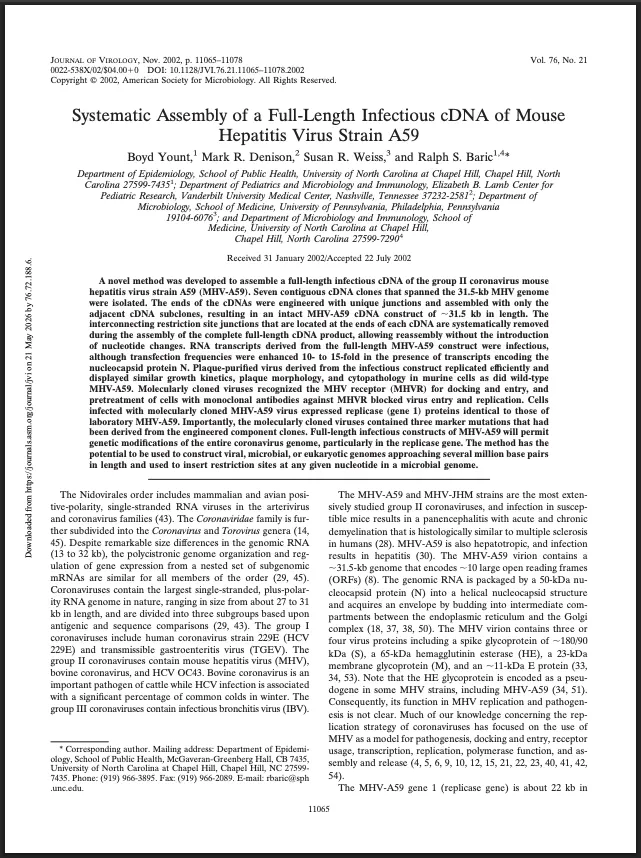
The paper, published November 1, 2002, in the Journal of Virology, was titled “Systematic Assembly of a Full-Length Infectious cDNA of Mouse Hepatitis Virus Strain A59” and described a new reverse-genetics platform for assembling an entire coronavirus genome from modular DNA fragments.
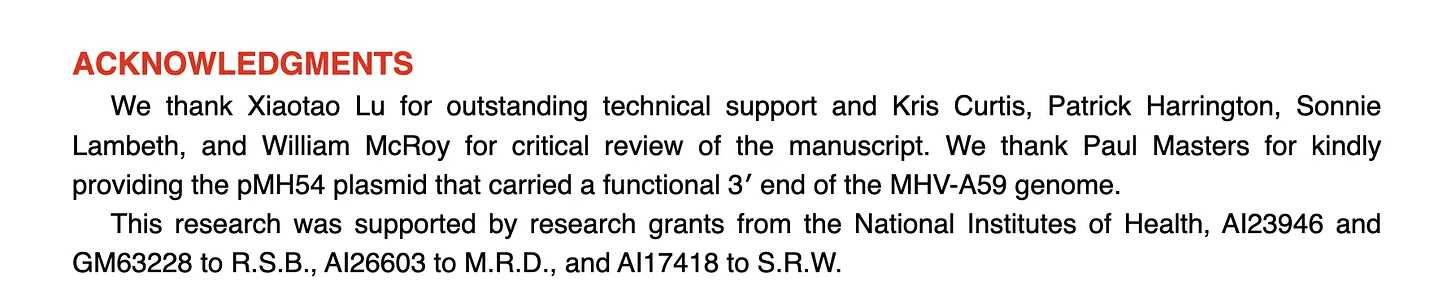
The work was financed by American tax dollars in the form of research grants from the National Institutes of Health (NIH): “AI23946 and GM63228 to R.S.B., AI26603 to M.R.D., and AI17418 to S.R.W.”
Before the SARS-CoV-1 outbreak was first reported, Baric’s 2002 paper had already established a programmable coronavirus reverse-genetics platform capable of modular genome assembly, seamless scarless reconstruction, targeted genetic manipulation, and purported recovery of infectious coronavirus material from engineered genetic sequences.
Those systems allowed researchers to rapidly design, modify, reconstruct, test, sequence, and mass-study coronaviruses in laboratory settings—capabilities that later became increasingly tied to diagnostics, vaccine development, genomic surveillance, pandemic-response research, and broader coronavirus preparedness infrastructure.
The timing raises obvious questions about whether the emergence of sophisticated government-backed coronavirus engineering systems and the beginning of the SARS era were truly independent events.
Follow us on Instagram @realjonfleetwood & Twitter/X @JonMFleetwood.
If you value this reporting, consider upgrading to a paid subscription.
For advertising & sponsorship opportunities, contact us by clicking below.
The study focused on mouse hepatitis virus (MHV), a Group II coronavirus, but the paper openly described a flexible system for engineering and reconstructing full-length coronavirus genomes.
“A novel method was developed to assemble a full-length infectious cDNA of the group II coronavirus mouse hepatitis virus strain A59,” the paper states.
The researchers explained that they divided the coronavirus genome into seven separate cDNA fragments, engineered unique junctions at the ends of the fragments, and then reassembled the entire genome into a full-length construct.
“The interconnecting restriction site junctions that are located at the ends of each cDNA are systematically removed during the assembly of the complete full-length cDNA product, allowing reassembly without the introduction of nucleotide changes,” the paper states.
Meaning, the engineered assembly markers used during construction did not remain visible in the final reconstructed genome.
The paper described this as “No See’m” technology: a scarless assembly method designed to regenerate the exact wild-type viral sequence at the junctions after assembly.
The authors explained the system this way:
“Upon cleavage and ligation with the adjoining fragment, both Esp3I sites are lost from the final product, leaving the exact MHV-A59 sequence at the junction.”
The study further stated:
“No evidence of the Esp3I site that has been engineered into the component clones should remain in the assembled product.”
The paper also emphasized that the platform allowed targeted manipulation across the coronavirus genome.
“Full-length infectious constructs of MHV-A59 will permit genetic modifications of the entire coronavirus genome,” the authors wrote.
The researchers additionally stated that the method had applications beyond coronaviruses:
“The method has the potential to be used to construct viral, microbial, or eukaryotic genomes approaching several million base pairs in length and used to insert restriction sites at any given nucleotide in a microbial genome.”
The timing of the publication is significant because the paper emerged at the exact historical moment the world entered the modern coronavirus outbreak era.
Practically, the paper described a system that allowed scientists to build and modify coronaviruses on the computer and in the lab, rapidly create testable virus models, and study how specific genetic changes affected the virus.
These capabilities are important for PCR test development, vaccine research, virus tracking, and large-scale pandemic-response programs after SARS emerged.
The manuscript was originally received by the journal on January 31, 2002, accepted on July 22, 2002, and ultimately published in the November 2002 issue of the Journal of Virology.
That same month, Chinese officials later said the first SARS-CoV-1 cases began appearing in Guangdong Province—an outbreak that would dramatically accelerate global investment into coronavirus sequencing, reverse genetics, PCR diagnostics, genomic surveillance, synthetic biology, vaccine platforms, and pandemic-response research infrastructure for the next two decades.
Years later, Baric would outline and patent how to engineer coronaviruses with SARS-CoV-2’s defining traits—a furin cleavage site (PRRA) insertion at the S1/S2 junction, targeted human-optimizing mutations throughout the receptor-binding domain (including the critical Q498 residue), and the two-proline (V1060P/L1061P) substitution to stabilize the spike protein in its prefusion conformation—just months before the COVID-19 pandemic began.
Follow us on Instagram @realjonfleetwood & Twitter/X @JonMFleetwood.
If you value this reporting, consider upgrading to a paid subscription.
For advertising & sponsorship opportunities, contact us by clicking below.


I think a more appropriate name would be the NII...National Institute of Illness.
With all that is going on, if an invisible Gain of Function V was available, did the NIH team let Wuhan strain leak to implicate China. Wars have been STARTED for less ?