
Baric Lab Published Blueprint for Computer-Designed Coronaviruses With No Detectable Assembly Scars in 2008
No See’m technique allowed Baric and colleagues to erase every visible fingerprint of laboratory genome assembly from the finished coronavirus genome.


A 2008 methods chapter from Ralph Baric’s laboratory openly published the complete protocol for digitally designing full-length coronavirus genomes on the computer, then physically assembling them into a final genome sequence while removing every visible engineering signature from that sequence.
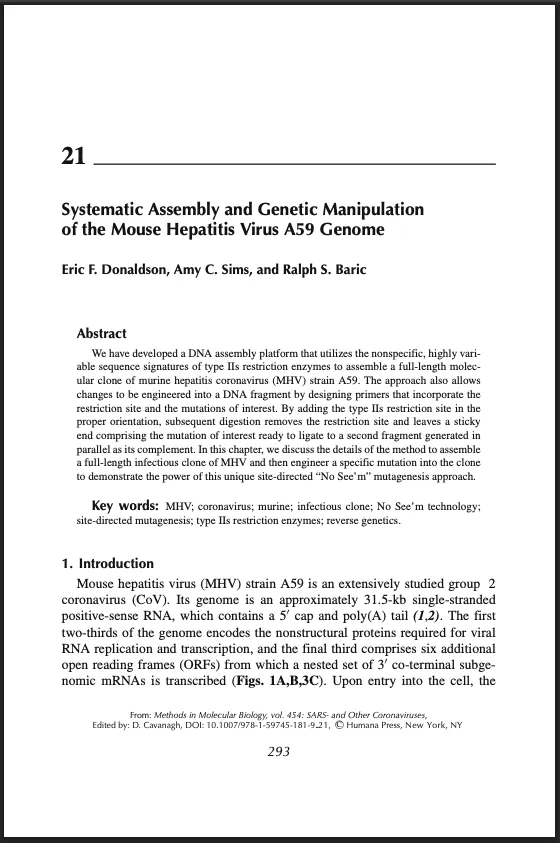
The chapter, titled “Systematic Assembly and Genetic Manipulation of the Mouse Hepatitis Virus A59 Genome,” was written by Eric F. Donaldson, Amy C. Sims, and Ralph S. Baric and published in Methods in Molecular Biology, a Springer/Humana Press book series of laboratory protocols.

Follow us on Instagram @realjonfleetwood & Twitter/X @JonMFleetwood.
If you value this reporting, consider upgrading to a paid subscription.
For advertising & sponsorship opportunities, contact us by clicking below.
The core of the system is the “No See’m” technique.
Baric had previously described this technique this way in a 2006 paper:
“No See’m sites can be used to insert foreign genes into viral, eukaryotic, or microbial genome or vector, simultaneously removing all evidence of the restriction sites that were used in the recombinant DNA manipulation.”
In the 2008 chapter, the authors explain how it works in practice on coronaviruses:
“We have developed a DNA assembly platform that utilizes the nonspecific, highly variable sequence signatures of type IIs restriction enzymes to assemble a full-length molecular clone of murine hepatitis coronavirus (MHV) strain A59. The approach also allows changes to be engineered into a DNA fragment by designing primers that incorporate the restriction site and the mutations of interest. By adding the type IIs restriction site in the proper orientation, subsequent digestion removes the restriction site and leaves a sticky end comprising the mutation of interest ready to ligate to a second fragment generated in parallel as its complement. In this chapter, we discuss the details of the method to assemble a full-length infectious clone of MHV and then engineer a specific mutation into the clone to demonstrate the power of this unique site-directed ‘No See’m’ mutagenesis approach.”
They divided the coronavirus genome into seven modular cDNA fragments.
Using computer-designed primers, they engineered temporary type IIs restriction sites into each fragment.
After digestion, those sites were completely removed.
The resulting scarless sticky ends were ligated together to form a full-length cDNA that contained only the exact sequence the researchers had programmed on the computer—with no leftover restriction sites, linkers, or other laboratory marks.
Without the No See’m technique, it’s said that the final assembled genome would have retained obvious laboratory scars: extra restriction enzyme sites at every junction, linker sequences, duplicated motifs, and other artificial cloning footprints that would immediately reveal the genome had been cut and pasted together in a lab.
The paper states the platform was already operational and widely used:
“Well over a hundred mutants have been engineered into the clone of MHV using this approach, which far exceeds the number for all other coronavirus reverse genetic systems reported. Moreover, this technology has been used to rapidly develop reagents in response to newly identified emerging coronaviruses.”
By 2008, Baric’s laboratory had already published the precise molecular framework needed to create computer-designed, traceless coronavirus genomes—final sequences that could be made to look like a naturally circulating strain.
Could the very scarless No See’m genome engineering framework Ralph Baric’s lab published in 2008—the ability to digitally design and physically assemble full-length coronavirus genomes while completely erasing every laboratory signature from the final sequence—explain why, despite years of intense international scrutiny, the true origin of SARS-CoV-2 remains unresolved?
Follow us on Instagram @realjonfleetwood & Twitter/X @JonMFleetwood.
If you value this reporting, consider upgrading to a paid subscription.
For advertising & sponsorship opportunities, contact us by clicking below.


Unresolved? You've resolved it for your morons.
“Scarless cloning” is a normal term in molecular biology. Similar methods are used across bacteria, yeast, plants, and viruses because researchers generally don't want extra undesired sequences introduced during assembly. This Baric paper shows coronavirus reverse genetic techniques existed before 2008. It does not prove SARS-CoV-2 was engineered, released, or intentionally modified. Technical capability is not evidence of causation.
SARS-CoV-2 genome lacks hallmarks associated with this or older engineering approaches.
The receptor-binding domain is compatible with natural selection.
Closely related viruses found in bats and other wildlife show that SARS-related coronaviruses naturally possess extensive diversity.
Now go search for more scary words for tomorrow's gift.
Computer designed corona viruses...all 100% fake.