
1985 Coronavirology Inferred Without Direct Observation That Two Coronaviruses Can Combine Their Genetic Material to Produce a New Coronavirus
U.S. government funded a decades-long coronavirus genetics enterprise built upon interpretations, not direct empirical observation—later inherited by Ralph Baric’s coronavirus engineering program.

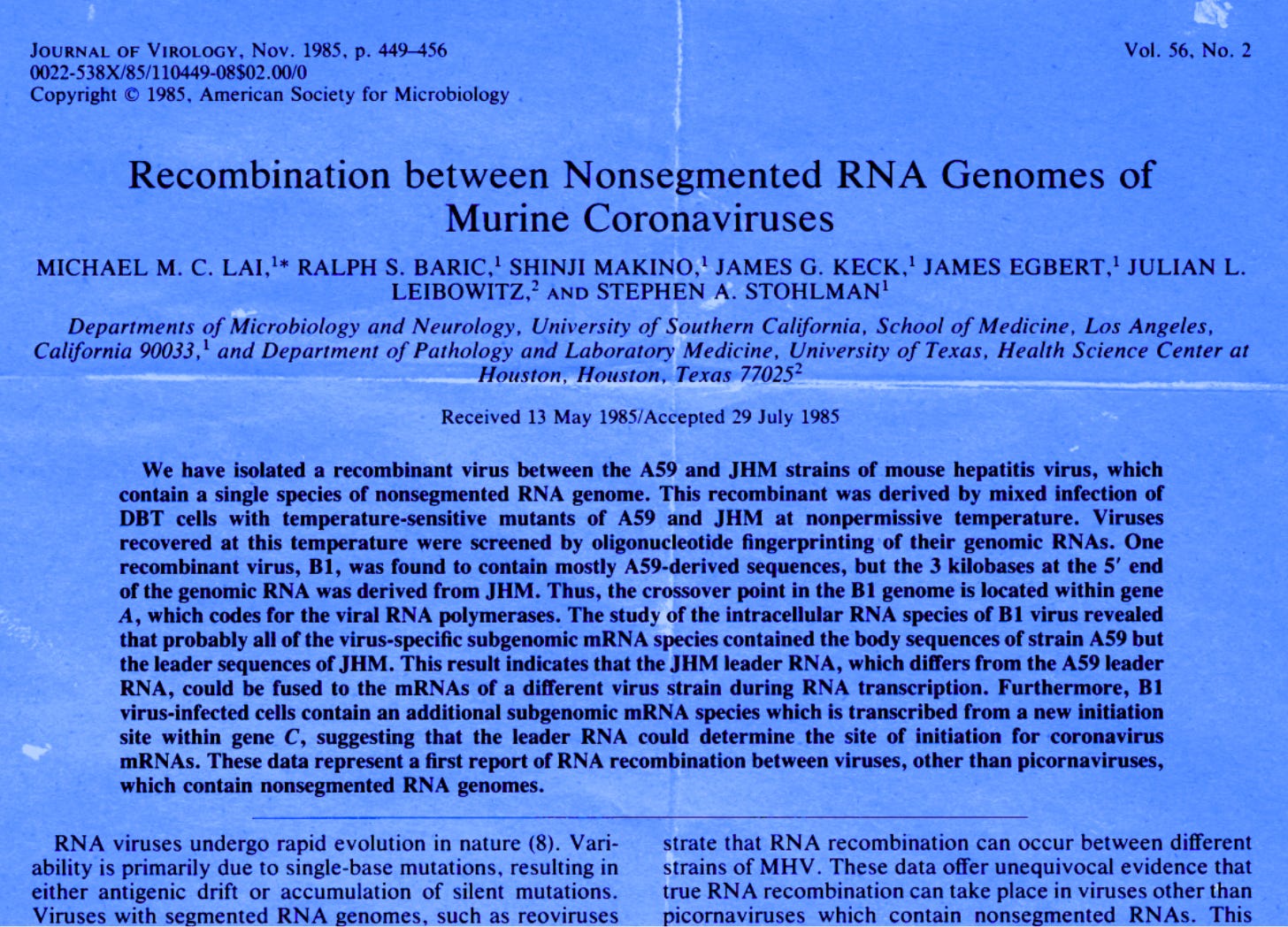
Modern coronavirus engineering rests on an earlier premise: that two coronaviruses can naturally contribute portions of what researchers regard as their genetic material to produce a new coronavirus.
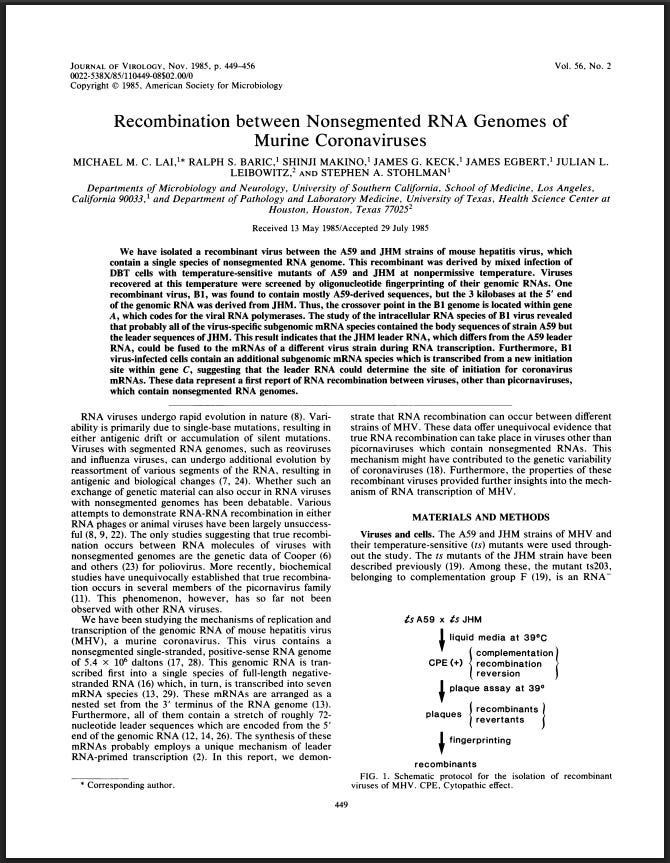
That premise entered the literature in a 1985 Journal of Virology paper co-authored by Michael M. C. Lai and Ralph S. Baric, not through direct observation of coronavirus genomes combining, but through interpretation of indirect laboratory readouts.
The paper and the work it described were funded by U.S. government grants RG 1449-A-1, PCM-4507, and Al 19244.
Baric is the U.S. taxpayer-funded coronavirologist whose decades of pre-2019 work claimed to explain down to the molecular level how to build coronaviruses with the defining properties (here) of the purported COVID-19 pandemic virus, SARS-CoV-2, before it was said to have emerged: having six segments separated by five restriction sites and a spike protein with optimized furin cleavage sites, receptor-binding domains, and two-proline vaccine constructs.
The complete provenance of the SARS-CoV-2 genome as presented to us by mainstream institutions has never been made public, meaning we cannot independently evaluate the complete evidentiary chain underlying that genome before it became the foundation for authoritarian government-led COVID-19 pandemic response decisions.
That raises a broader question about the evidentiary foundation of coronavirus genetics as a whole and its relation to the government.
Lai, Baric’s predecessor and the government-funded “father of coronavirus research,” had already established how to attribute molecular and genetic properties to coronaviruses through interpretation of laboratory measurements rather than direct observation.
In the 1985 paper, Lai, Baric, and their co-authors extended that framework by claiming that two coronavirus strains could contribute different portions of what they regarded as their genomes to produce a new coronavirus.
But the paper confirms that claim did not come from directly observing two coronavirus genomes combining.
It came from interpreting indirect laboratory readouts generated from mixtures of biological material that had been cultured, radiolabeled, centrifuged, chemically processed, enzymatically digested, and separated through electrophoresis.
That raises a fundamental question:
If modern coronavirus engineering rests on the premise that coronaviruses naturally combine portions of what researchers regard as their genetic material to produce new coronaviruses, and that premise itself entered the literature through interpretation of indirect laboratory readouts rather than direct observation, how much of modern coronavirus genetics ultimately rests on inherited interpretations rather than directly observed phenomena?
Moreover, COVID-19 lockdowns, mask mandates, vaccine campaigns, social-distancing policies, case counts, diagnostic testing, and countless other government decisions all rested, in part, on the molecular understanding of coronavirus presented by modern coronavirology.
Which raises another question:
If later science and policy depended on a particular scientific framework, and this article traces one of that framework’s foundational premises back to its origin, what should we conclude about the evidentiary basis of the framework itself?
And:
Why did the U.S. government spend decades funding the development of a coronavirus molecular framework whose foundational premises are based on interpretation rather than direct observation, then later rely on that same framework to justify lockdowns, mask mandates, vaccine campaigns, social distancing, diagnostic testing, and countless other COVID-19 response policies?


Follow us on Instagram @realjonfleetwood & Twitter/X @JonMFleetwood.
If you value this reporting, consider upgrading to a paid subscription.
For advertising & sponsorship opportunities, contact us by clicking below.
Lai Had Already Attributed Genetic Properties to Coronavirus
The 1985 paper did not begin from scratch.
Seven years earlier, Lai and Stohlman’s taxpayer-funded 1978 paper, RNA of Mouse Hepatitis Virus, attempted to establish what coronavirus was understood to be at the molecular level.
The researchers collected material from treated cell cultures, separated portions of it through centrifugation, chemically processed the recovered material, and subjected it to laboratory tests.
Those procedures produced measurements:
sedimentation behavior;
migration patterns;
RNase sensitivity;
and binding in a poly(A) assay.
They did not directly observe what the paper ultimately described as the coronavirus genome.
The authors instead interpreted those laboratory measurements as indicating that coronavirus possessed one large, single-stranded RNA molecule that was “probably positive stranded” and had a particular estimated molecular weight and coding capacity.
Those attributed genetic properties became part of the molecular framework inherited by later coronavirology.
The field increasingly stopped asking whether coronavirus possessed the proposed genome described by Lai and began asking how that genome was organized, transcribed, recombined, reconstructed, and manipulated.
The 1985 Paper Asked Whether Coronaviruses Could Exchange Genetic Material
The 1985 paper explicitly framed the unresolved question:
“Whether such an exchange of genetic material can also occur in RNA viruses with nonsegmented genomes has been debatable.”
The authors acknowledged that earlier attempts to demonstrate the claimed phenomenon had been “largely unsuccessful.”
They wrote:
“Various attempts to demonstrate RNA-RNA recombination in either RNA phages or animal viruses have been largely unsuccessful.”
They further stated that, outside of one group of agents called picornaviruses, the claimed phenomenon had not previously been observed:
“This phenomenon, however, has so far not been observed with other RNA viruses.”
The paper therefore sought to establish that two strains of mouse hepatitis virus (A59 and JHM) could contribute different portions of what the authors regarded as their genomes to produce a third coronavirus containing parts attributed to both.

What the Researchers Physically Did
The researchers placed cultured DBT or L-2 cells in wells and added preparations identified as temperature-sensitive mutants of the A59 and JHM coronavirus strains.
They maintained the cells under different temperature conditions and marked wells displaying what they called cytopathic effects.
Material from those wells was harvested, subjected to plaque procedures and propagated.
The researchers then radiolabeled recovered material, separated portions through sucrose-gradient sedimentation and agarose-gel electrophoresis, extracted selected material from gels, and treated it with enzymes.
The paper describes the principal analytical method:
“Oligonucleotide fingerprinting analysis was performed by two-dimensional polyacrylamide gel electrophoresis of RNase T1-resistant oligonucleotides.”
Selected spots were then treated with RNase A and separated by DEAE paper electrophoresis for what the authors called base-composition analysis.
The direct products of those procedures were fingerprint spots, bands, migration patterns and calculated base compositions.
They were not direct observations of coronavirus genomes combining.


The Fingerprint Patterns Became ‘Recombination’
The researchers compared the fingerprint pattern attributed to a recovered preparation called B1 against patterns previously attributed to the A59 and JHM strains.
They reported that B1 contained most spots assigned to A59 but lacked several A59-associated spots.
They also reported that B1 contained spots assigned to JHM.
From those spot-pattern comparisons, they concluded:
“These results strongly indicate that B1 virus represents a true recombinant between A59 and JHM, with the crossover point roughly 3 kilobases from the 5′ end of the genome.”
The fingerprint patterns are visible on pages 2 and 4 of the paper (seen above).
The authors labeled particular spots as belonging to A59, JHM or B1, then used their presence or absence to construct the genome diagram on page 3 showing a proposed JHM-derived section attached to a largely A59-derived remainder.
The diagram was not a direct image of a combined genome.
It was a schematic interpretation constructed from the fingerprint spots and from genomic locations assigned in earlier publications.


The Paper Declared the Inference Established
The paper’s abstract did not describe the conclusion as tentative.
It stated:
“One recombinant virus, B1, was found to contain mostly A59-derived sequences, but the 3 kilobases at the 5′ end of the genomic RNA was derived from JHM.”
It then announced:
“These data represent a first report of RNA recombination between viruses, other than picornaviruses, which contain nonsegmented RNA genomes.”
The introduction was even stronger:
“These data offer unequivocal evidence that true RNA recombination can take place in viruses other than picornaviruses which contain nonsegmented RNAs.”
In the discussion, the authors declared:
“The data presented in this report clearly established that true genetic recombination occurs between nonsegmented RNAs during the replication of murine coronaviruses.”
They then extended the inferred laboratory event into a broader explanation of coronavirus development:
“RNA recombination is likely to have contributed to the diversity of coronaviruses.”
This is where a series of indirect laboratory readouts became a foundational statement about what coronaviruses supposedly do.
The Claimed Event Was Never Directly Observed
Despite declaring that “true genetic recombination” had been “clearly established,” the authors did not directly observe:
two coronavirus genomes;
one genome physically interacting with another;
genetic material moving between them;
the proposed crossover;
or the production of a combined genome inside a cell.
The authors acknowledged:
“The mechanism of recombination is not clear at the present time.”
They then proposed a possible mechanism using explicitly speculative language:
“These RNA intermediates could conceivably bind back to the negative-stranded RNA templates of a different virus in a mixedly infected cell and generate RNA recombinants.”
“Could conceivably” describes a proposed explanation for an event that was not observed.
The instruments produced patterns from processed laboratory material.
The paper supplied the biological identities, genomic locations, crossover event, and mechanism attributed to those patterns.
Baric Was Present When the Premise Entered Coronavirology
Baric was not merely a later researcher who cited this paper.
He was its second-listed author.
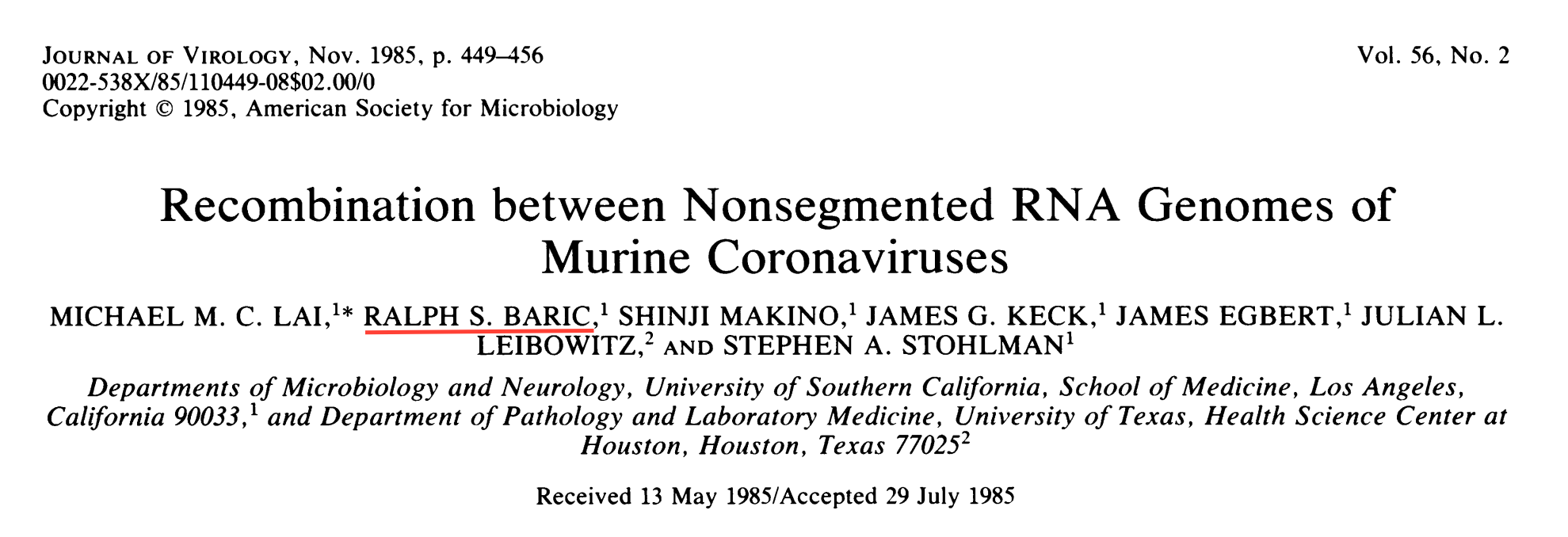
The paper appeared during the period when Baric was working directly with Lai and Stohlman and helping extend the molecular framework developed through Lai’s earlier coronavirus research.
The progression is direct.
In 1978, Lai and Stohlman interpreted sedimentation, electrophoresis, enzymatic sensitivity and binding measurements as revealing the proposed molecular properties of a coronavirus genome.
In 1985, Lai, Baric and their co-authors interpreted fingerprint patterns and related assays as “showing” that two coronaviruses could contribute different portions of their supposed genomes to produce a new coronavirus.
Later, Baric’s laboratory developed methods for deliberately reconstructing, modifying and assembling coronavirus genomes.
The earlier inference no longer had to be established.
It became an assumption within the research program.
From Inferred Natural Combination to Deliberate Laboratory Assembly
The importance of the 1985 paper is therefore larger than the claimed identification of one “recombinant.”
It helped establish that coronavirus genomes were modular and interchangeable.
Or, more precisely, that corresponding regions attributed to separate coronavirus genomes could be combined while producing what researchers interpreted as a functioning new coronavirus.
Later coronavirus engineering adopted the same conceptual framework deliberately.
Researchers no longer merely claimed that coronavirus genetic regions combined during an unobserved natural process.
They began selecting, replacing, mutating, and assembling the regions themselves.
The conceptual progression was:
Indirect measurements were interpreted as defining the coronavirus genome.
Then: Indirect fingerprint patterns were interpreted as showing that portions of two coronavirus genomes had combined.
Then: That inferred capacity became accepted background for deliberately manipulating and assembling coronavirus genomes in the laboratory.
Bottom Line
The significance of the 1985 Lai-Baric paper extends far beyond its reported experiment.
It helped establish one of the foundational premises of modern coronavirology: that two different coronaviruses can contribute different portions of what researchers regard as their genetic material to produce a new coronavirus.
The paper did not report directly observing two coronavirus genomes physically combining.
Instead, it interpreted fingerprint patterns, electrophoretic separations, base-composition analyses, and other indirect laboratory readouts generated from processed biological material as representing that event.
The paper then declared that “true genetic recombination” had been “clearly established,” while simultaneously acknowledging that “the mechanism of recombination is not clear” and proposing only that the claimed process “could conceivably” occur.
That inferred premise did not remain confined to one paper.
It became accepted background within coronavirology.
Later researchers, including Ralph Baric, generally inherited it rather than establishing it again from direct observation, then built increasingly sophisticated methods for reconstructing, modifying, and engineering coronavirus genomes upon it.
The historical question raised by this paper is therefore larger than coronavirus engineering alone.
If foundational premises of modern coronavirus genetics entered the scientific literature through interpretation of indirect laboratory readouts rather than direct observation of the claimed biological events, and that same molecular framework later informed pandemic diagnostics, genomic surveillance, vaccine development, and many of the scientific claims underlying the government’s COVID-19 response, what does that imply about the evidentiary foundation upon which the entire framework was built?
Follow us on Instagram @realjonfleetwood & Twitter/X @JonMFleetwood.
If you value this reporting, consider upgrading to a paid subscription.
For advertising & sponsorship opportunities, contact us by clicking below.


I found the exact same thing when I researched bird flu. The same guys who were making juiced up human-bird flus also concocted a natural human-bird flu story, with the help of the WHO and in service of Gilead (Tamiflu & Remdesivir): https://scamerica.substack.com/p/because-of-superinfection-exclusion
Thank you, Jon!
Never quit speaking, Jon!
Your voice matters and is appreciated more than you know!