
Gates Foundation Funds Injectable Hydrogel Vaccine Tested Against H5N1 Bird Flu: Journal 'Biomaterials Science'
Hydrogel forms a "depot" under the skin, slowly releasing vaccine components for weeks.


Researchers at Stanford University, funded by the Bill & Melinda Gates Foundation with lab infrastructure funded by the U.S. National Institutes of Health (NIH), have developed an injectable hydrogel vaccine platform designed to remain in the body and slowly release vaccine components for weeks, including formulations tested using H5N1 avian influenza (“bird flu”) antigens.
The move comes amid state-level, national, and international bird flu pandemic orchestration.
Follow us on Instagram @realjonfleetwood & Twitter/X @JonMFleetwood.
If you value this reporting, consider upgrading to a paid subscription.
For advertising & sponsorship opportunities, contact us by clicking below.
The technology relies in part on Pluronic F-127 (poloxamer 407), a polymer capable of forming a gel deposit after injection.
Scientific literature examining this same polymer shows that when it was used as a delivery medium in animal experiments, it dramatically increased the lethality of inflammatory toxins—reducing the lethal dose (LD50) of bacterial endotoxin in mice by roughly 10–15-fold, meaning animals were far more likely to die from the toxin when the polymer was present (see more on this below).
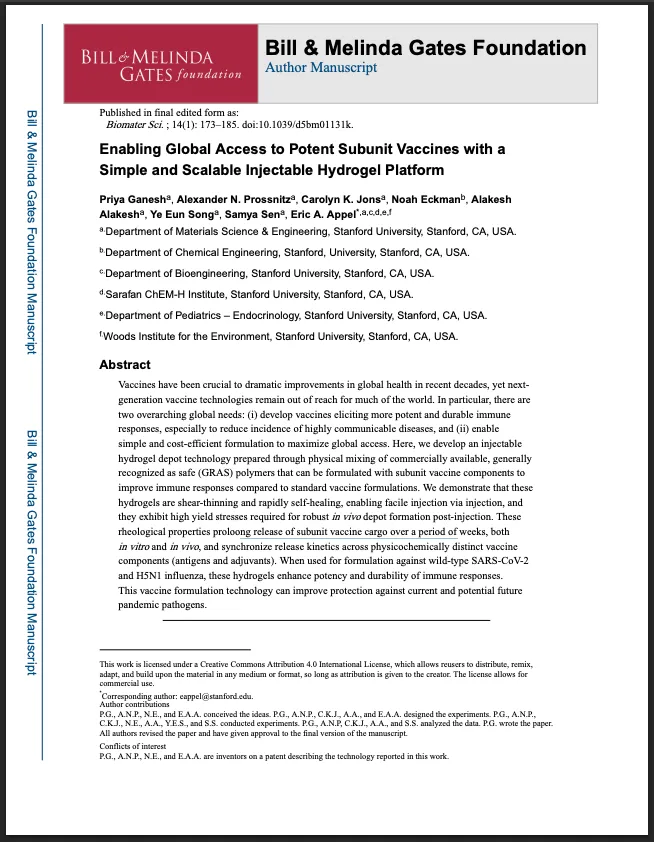
The hydrogel vaccine platform is described in the study “Enabling Global Access to Potent Subunit Vaccines with a Simple and Scalable Injectable Hydrogel Platform,” published in January in the Royal Society of Chemistry’s peer-reviewed journal Biomaterials Science.
The work was led by Eric A. Appel, a materials scientist at Stanford University, along with collaborators across multiple Stanford biomedical research programs.
According to the paper, the system forms a hydrogel depot in tissue after injection, allowing vaccine components to remain localized and be released gradually over time.
The authors wrote that the hydrogel platform can “prolong release of subunit vaccine cargo over a period of weeks.”
The experimental system was tested using the purported hemagglutinin protein from the H5N1 influenza virus, the viral surface protein commonly targeted in bird-flu vaccine research.
Organizations Involved
The hydrogel vaccine technology was developed at Stanford University with financial support and laboratory infrastructure from multiple sources.
Research Institution
Stanford University
Funding and Research Support Acknowledged in the Study
Bill & Melinda Gates Foundation
U.S. National Institutes of Health (NIH), which supported laboratory research infrastructure through Shared Instrumentation Grant 1S10OD026831-01
The Gates Foundation provided funding supporting the development of the vaccine platform itself.
The NIH grant cited in the research funded a shared laboratory instrument used during the experiments—a high-parameter flow cytometer located in Stanford’s Shared FACS Facility.
Polymer Hydrogel Carrier
The injectable gel used in the platform is built from Pluronic F-127 (poloxamer 407), a synthetic polymer designed to form a semi-solid depot inside the body after injection.
Scientific research examining this same polymer has found that it can dramatically intensify inflammatory toxicity in animal experiments.
In one study published in Critical Care Medicine, researchers delivered bacterial endotoxin (lipopolysaccharide, or LPS) to mice using Pluronic F-127 instead of saline.
The results showed that the amount of toxin required to kill half the animals dropped 10–15-fold when the polymer was present.
In practical terms, mice were far more likely to die from the same toxin dose when it was delivered in the polymer hydrogel.
The experiment also found that mice exposed to the polymer showed significantly higher levels of inflammatory cytokines, including tumor necrosis factor and interleukin-6, indicating that the polymer can amplify inflammatory responses in the body.
Viral Antigen
The experimental vaccine tested in the hydrogel platform used the hemagglutinin (HA) protein from the H5N1 avian influenza virus, the viral surface protein often targeted in bird-flu vaccine development.
The Stanford system embeds the HA protein within the hydrogel matrix and is released gradually over time.
Researchers claim sustained exposure to viral antigens is intended to prolong immune stimulation, meaning immune cells can encounter the same antigen repeatedly for extended periods after a single injection.
Immune-Stimulating Adjuvant
The hydrogel vaccine platform also incorporates 3M-052, a synthetic immune-stimulating compound designed to activate TLR7 and TLR8, receptors that trigger powerful inflammatory immune signaling.
Data on 3M-052 (also known as MEDI9197 or telratolimod) from its phase 1 clinical trial in patients with advanced solid tumors (NCT02556463), where intratumoral injections caused severe toxicities that limited dosing and included a treatment-related death: nearly all participants (80-94%) experienced drug-related adverse events, with the most common being fever (56%), fatigue (31%), and nausea (21%) (Siu et al., 2020, PMID: 33037117).
Severe (grade ≥3) related events affected 30-40% of patients, including decreased lymphocytes (15%), neutrophils (10%), and white blood cell counts (10%) (Siu et al., 2020).
Dose-limiting toxicities included cytokine release syndrome (one grade 3 and one grade 4 at doses of 0.037 mg and 0.055 mg in monotherapy).
In the combination arm with durvalumab, escalation stopped at just 0.012 mg due to a grade 5 (fatal) event: hemorrhagic shock from rupture of a liver metastasis 4 days after the second injection, deemed related to MEDI9197.
Preclinically, in nonhuman primate studies using 3M-052 as an HIV-1 envelope vaccine adjuvant (often in nanoparticles), high initial doses (750 μg) caused severe localized reactions including swelling, redness, and ulceration in several animals (2/8 and 4/14 across groups) weeks post-injection, requiring a 10-fold dose reduction to 75 μg and site changes to prevent worsening harm (Kasturi et al., 2021, PMC8109745).
Bottom Line
The Gates Foundation–funded research conducted at Stanford University describes an experimental hydrogel vaccine platform designed to remain in tissue and release vaccine components for weeks, including formulations targeting H5N1 bird flu.
The system relies on a polymer hydrogel depot that traps vaccine components under the skin and releases them gradually over time.
Scientific literature examining key ingredients used in the platform raises significant safety concerns.
Studies of the hydrogel polymer poloxamer 407 show that when it was used as a delivery medium in animal experiments, it reduced the lethal dose of bacterial endotoxin by 10–15 fold, meaning animals were far more likely to die from the toxin when the polymer was present.
Research on the immune-stimulating adjuvant 3M-052 has documented severe inflammatory reactions, cytokine release syndrome, and dose-limiting toxicities in human trials, including a treatment-related death, while earlier primate studies reported ulceration and severe injection-site damage at higher doses.
This shows that the same materials used to construct the experimental hydrogel vaccine system are capable of triggering powerful inflammatory responses and serious adverse effects under certain conditions, raising important questions about safety as long-acting vaccine delivery technologies continue to be developed.
Follow us on Instagram @realjonfleetwood & Twitter/X @JonMFleetwood.
If you value this reporting, consider upgrading to a paid subscription.
For advertising & sponsorship opportunities, contact us by clicking below.


Any person that take ANY vaccine or trusts Bill Gates and our health agencies needs more than a vaccines. They need a brain transplant.
100% lies as are all vaccines. There is no birdy flew. But they want you to be scared enough to get more mRNA poisons. Oh goody...poisons spread out over weeks. What will they think of next?