
NIAID-Funded Scientists Engineer Mutant Influenza Virus and 'Expand its Host Range': Journal ‘Nature Communications’
Gain-of-function flu pathogen acquires new cell entry function, expands infection capability.

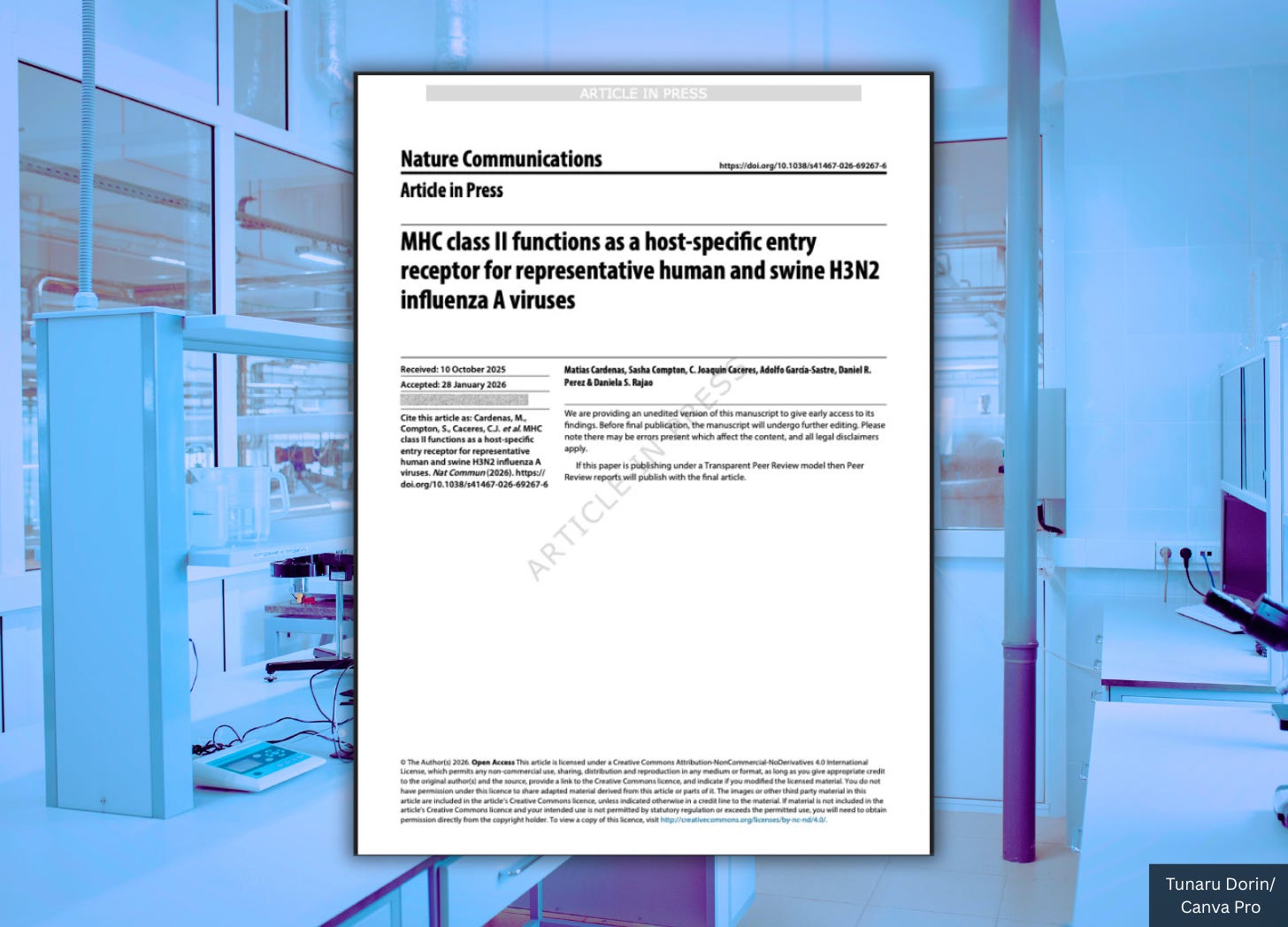
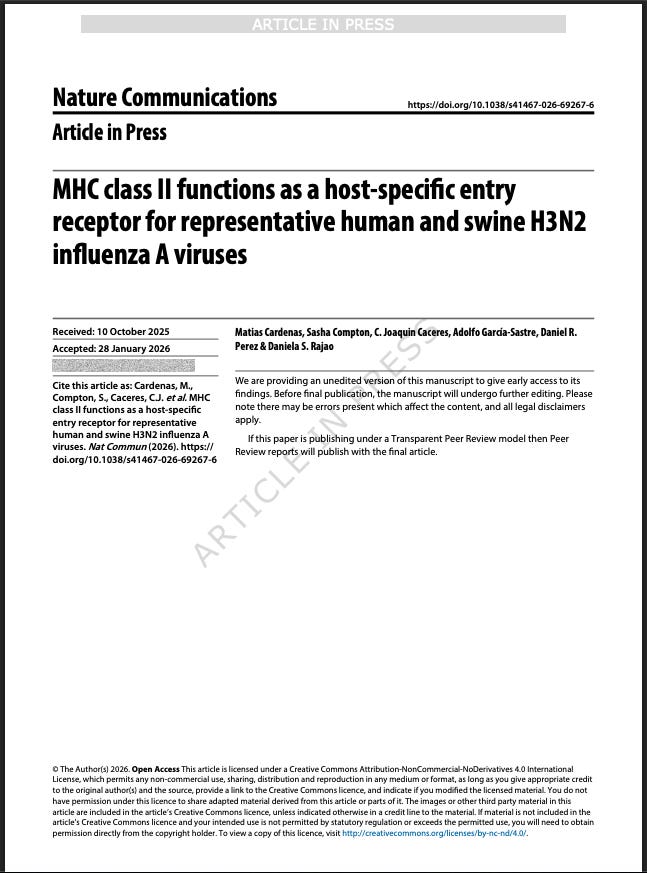
Scientists funded by the National Institute of Allergy and Infectious Diseases (NIAID) engineered influenza viruses and introduced mutations that expanded the virus’s host range—an outcome that the National Institutes of Health (NIH) itself formally defines as gain-of-function research under a 2025 Executive Order implementation notice.
The study, published in Nature Communications last week, confirms the work was funded through a NIAID influenza research center.
The authors state:
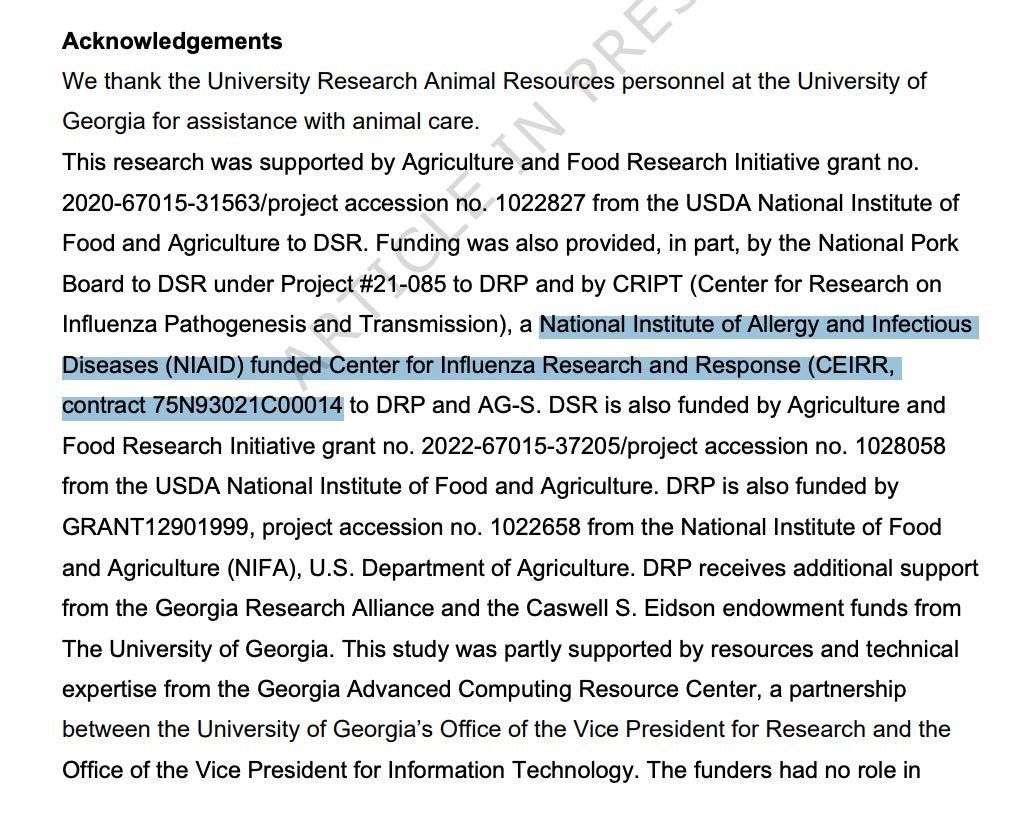
“Funding was also provided, in part, by … CRIPT (Center for Research on Influenza Pathogenesis and Transmission), a National Institute of Allergy and Infectious Diseases (NIAID) funded Center for Influenza Research and Response (CEIRR, contract 75N93021C00014…).”
The CEIRR network is one of NIAID’s primary federally funded influenza research programs.
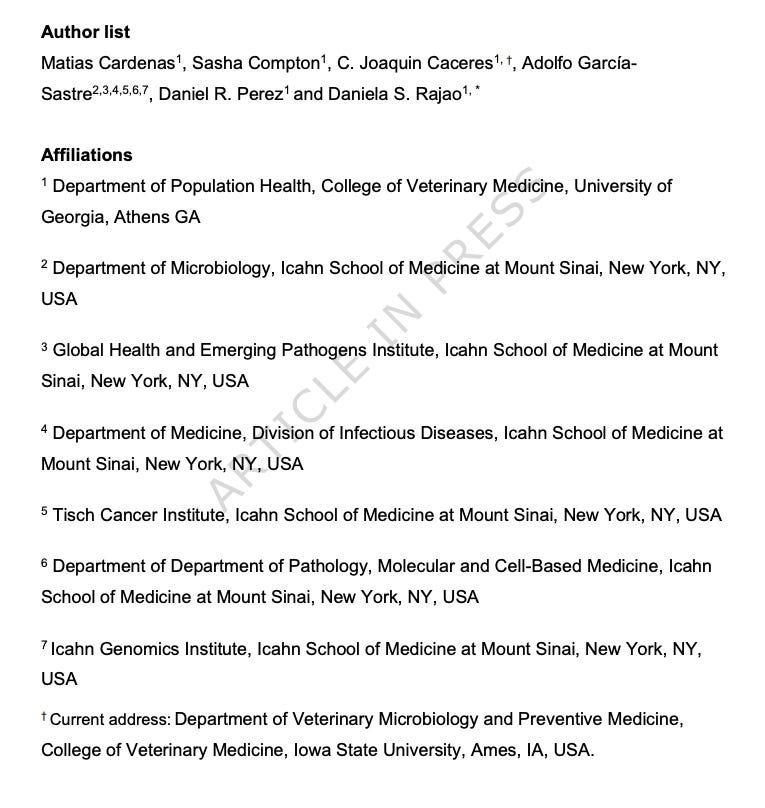
The current Director of NIAID—allowing such risky influenza lab engineering—is Dr. Jeffery Taubenberger, who holds a patent on the technology behind the Trump administration’s $500 million influenza vaccine platform.
The same federal agency funding the creation of mutated influenza viruses is led by the man who helped invent—and could profit from—the vaccine meant to fight them.
Moreover, the study comes as Congress and President Donald Trump have enacted a new law allocating more than $5.5 billion in taxpayer funding for pandemic preparedness, with influenza—the same pathogen engineered in these experiments—named as the only virus explicitly identified in the statute.
Funding for the experiment also came from the U.S. Department of Agriculture (USDA).
Follow us on Instagram @realjonfleetwood & Twitter/X @JonMFleetwood.
If you value this reporting, consider upgrading to a paid subscription.
For advertising & sponsorship opportunities, contact us by clicking below.
Scientists Say They Built Live Influenza Viruses Using Genetic Engineering
The researchers say they reconstructed infectious influenza viruses in the laboratory using reverse genetics, a system that is said to allow scientists to generate live viruses and introduce mutations.
The study reads:
“FLUAV viruses in this study were generated using an 8-plasmid reverse genetic system as previously described…”
This process is said to produce fully infectious influenza viruses whose biological properties can be experimentally altered.
Engineered Mutations Expanded Host Range
The researchers introduced mutations into a human influenza virus and found that those changes allowed the virus to infect cells using both human and swine receptors.
The study states:
“Introduction of these single point mutations… allowed utilization of both HLA-DR and SLA-DR” as entry receptors.
HLA-DR is the human receptor.
SLA-DR is the swine receptor.
The authors concluded that these engineered mutations resulted in a fundamental functional shift:
“Enabling the virus to expand its host range.”
Host range refers to the species and cell types a virus can infect.
NIH Official Policy Explicitly Defines Host-Range Alteration as Gain-of-Function
On June 18, 2025, the National Institutes of Health issued Notice NOT-OD-25-127, implementing the White House Executive Order on biological research safety.
That notice provides the controlling federal definition of dangerous gain-of-function research.
NIH states:
“Dangerous gain-of-function research means scientific research on an infectious agent or toxin with the potential to cause disease by enhancing its pathogenicity or increasing its transmissibility.”
The policy then lists specific experimental outcomes that qualify as gain-of-function, including:
“(e) altering the host range or tropism of the agent or toxin.”
This means that under NIH’s own definition, experiments that alter a virus’s host range fall within the federal gain-of-function category.
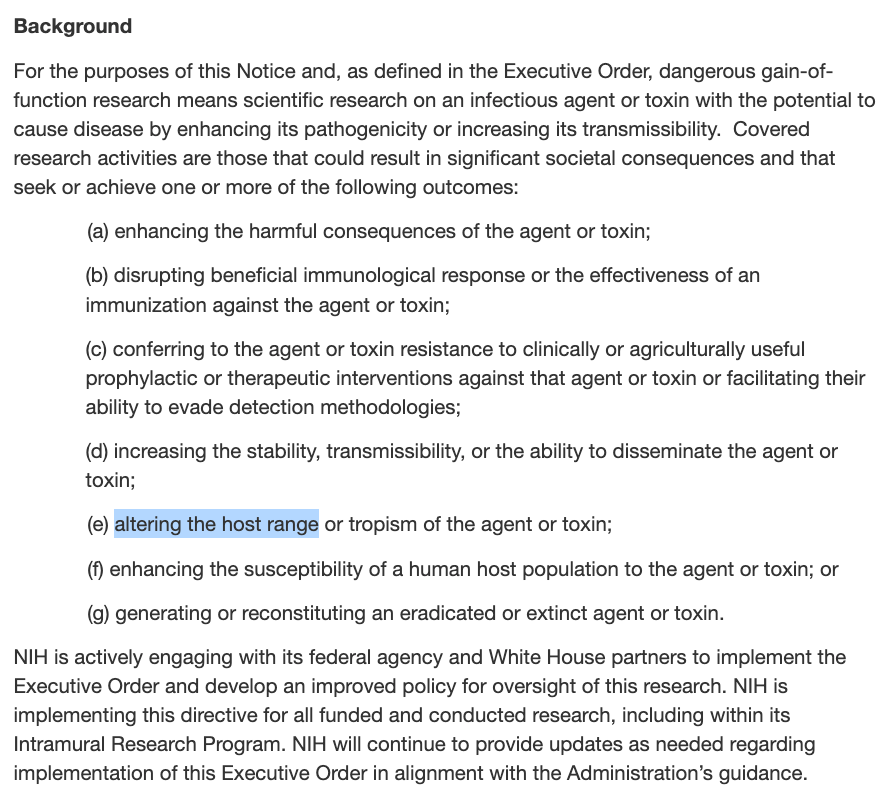
The influenza study’s finding that engineered mutations were “[e]nabling the virus to expand its host range” matches the exact gain-of-function criterion defined by NIH.
Under Notice NOT-OD-25-127, NIH announced:
“NIH will… terminate funding… and suspend all other funding… meeting the definition of dangerous gain-of-function research.”
The agency also ordered researchers to review ongoing NIH-funded projects and report gain-of-function research.
The study was received and conducted within the same timeframe that NIH issued its June 18, 2025 directive mandating termination or suspension of federally funded gain-of-function research, raising questions about whether the NIAID-funded host-range expansion experiment was reviewed, reported, or allowed to proceed under the Executive Order’s new enforcement requirements.
Mutant Influenza Gained Ability to Infect Cells Through New Entry Pathway
Influenza viruses are said to typically infect cells using sialic acid receptors.
But the engineered mutations enabled infection through an alternate receptor pathway.
The researchers reported:
“Our findings revealed that MHCII can serve as a sialic acid-independent entry receptor to H3N2 FLUAV.”
They confirmed this experimentally:
“Under sialic acid-depleted conditions, FLUAV only infected MHCII-expressing cells.”
This demonstrated that the engineered virus gained an additional infection mechanism.
Engineered Virus Successfully Replicated & Destroyed Cells
The researchers say the virus completed full infection cycles using the alternate entry pathway.
They wrote:
“MHCII-mediated entry… leads to productive infection and cell death.”
This means the virus is said to have successfully replicated and killed infected cells.
Bottom Line
The NIAID- and USDA-funded study affirms that scientists engineered influenza viruses and introduced mutations that expanded host range and altered infection capability.
The researchers themselves concluded the mutations were:
“Enabling the virus to expand its host range.”
NIH’s own controlling policy explicitly defines altering host range as gain-of-function research.
Because NIH issued an earlier directive ordering termination or suspension of federally funded gain-of-function research, and this study was received and conducted within that same timeframe, it remains unclear whether the federally funded host-range expansion experiment was reviewed, reported, suspended, or permitted to proceed under the Executive Order’s enforcement requirements.
Follow us on Instagram @realjonfleetwood & Twitter/X @JonMFleetwood.
If you value this reporting, consider upgrading to a paid subscription.
For advertising & sponsorship opportunities, contact us by clicking below.


Why is there no discussion of these GoF clones inability to replicate outside their E.coli bacterial cultures? How is it nobody contrasts the bad models with reality that it is biologically impossible for RNA to spread like Cat in the Hat pink snow outside these cultures that hijack bacteria to accomplish replication? Where is any explanation of GoF as nothing but pure clones grown in bacteria & stuffed into rodents as a bad proxy for infectious cycle?
Is there anyone who will expose the fraud of virology models distorted to reality simply because they are justification for vaccine stockpiles??
https://web.archive.org/web/20161206155142/http://www.gryphonscientific.com/wp-content/uploads/2016/04/Risk-and-Benefit-Analysis-of-Gain-of-Function-Research-Final-Report.pdf
Conflict of Interest doesn't matter at the NIAID?
"The current Director of NIAID—allowing such risky influenza lab engineering—is Dr. Jeffery Taubenberger, who holds a patent on the technology behind the Trump administration’s $500 million influenza vaccine platform."