
DARPA/NIH-Funded Scientists Reprogram Dormant Influenza Parts With New Replication and Competition-Suppressing Functions
New 'Nature Communications' study shows U.S. military and health agencies bankroll GOF experiments giving flu stronger ability to multiply and to suppress competing natural influenza viruses.

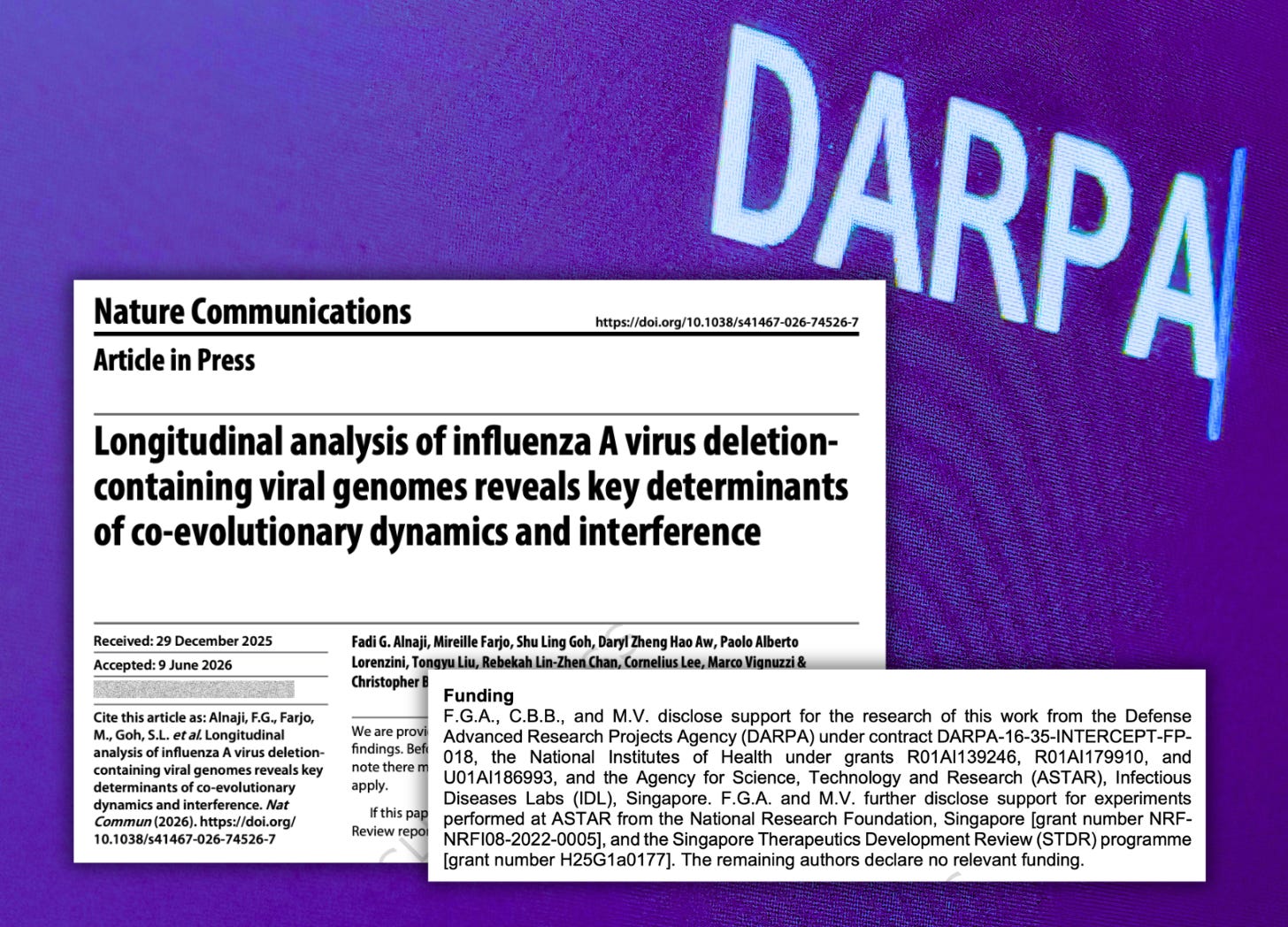
DARPA- and NIH-funded scientists published a study on Tuesday in which they claim to have enhanced the defective parts of the influenza genome with new replication and competition-suppressing functions, transforming previously dormant components of influenza into more powerful ones.
The revelation comes as U.S. taxpayers fund research behind Moderna’s new mRNA-1010 (MFLUSIVA) influenza vaccine, raising questions about why Americans are funding both the manipulation of pathogens linked to outbreaks as well as the injectable “solution” to those outbreaks at the same time.
In the years before the COVID-19 pandemic, DARPA (Defense Advanced Research Projects Agency) was working with Moderna on an mRNA coronavirus vaccine, while at the same time working with EcoHealth on how to engineer coronaviruses with a furin cleavage site, human-optimized receptor binding domain, and two-proline spike mutation—the defining characteristics of what would be the COVID-19 virus.
Published in Nature Communications, the new study focused on what researchers call deletion-containing viral genomes (DelVGs)—defective pieces of influenza that contain large deletions in essential viral genes.
According to the authors, these influenza-derived genetic elements are defective because they “cannot replicate independently.”
In other words, the researchers were not claiming to be working with normal influenza genomes.
They were working with defective ones.
Rather than leaving those defective influenza elements unchanged, the researchers say they experimentally enhanced them.
The paper states that a specific modification “significantly enhances DelVG replication and interference potency.”
Those are the study’s words.
Enhanced replication.
Enhanced interference potency.
The authors further reported that the modification “enhances the replication and intracellular competitive advantage” of the defective influenza genome.
In plain English, scientists took defective influenza genetic elements and made them better at replicating and better at competing.
You can contact NIAID here, NIH here, and HHS here to voice opposition to taxpayer-funded research on pandemic pathogens—particularly after Congress, the White House, the Department of Energy, the FBI, the CIA, and Germany’s Federal Intelligence Service (BND) all acknowledged that the COVID-19 pandemic was “likely” the result of a laboratory incident involving engineered pathogens.
You can contact DARPA here.
Critics argue that the simultaneous development of a pandemic problem and its solution raises questions about the government’s intent, international security, and informed consent.
Follow us on Instagram @realjonfleetwood & Twitter/X @JonMFleetwood.
If you value this reporting, consider upgrading to a paid subscription.
For advertising & sponsorship opportunities, contact us by clicking below.
Enhanced Influenza Parts Suppress Natural Influenza Viruses
A striking aspect of the study is what those enhanced functions actually do.
The modified influenza elements did not merely gain stronger replication abilities.
They were also said to have become better at suppressing competing influenza viruses.
That is what the researchers mean by enhanced “interference potency.”
The engineered influenza-derived elements are said to have gained a stronger ability to interfere with the replication of normal influenza viruses sharing the same purportedly infected cells.
The stated result was a defective influenza-derived competitor that became better at suppressing the natural influenza viruses it depended on.
The paper repeatedly says that the modified influenza elements outperformed earlier versions.
According to the authors, the enhanced defective genome gained a competitive advantage and became increasingly dominant during laboratory experiments.
The researchers did not simply observe these changes.
They claim to have generated the modified influenza-derived particles and experimentally demonstrated the enhanced functions in the laboratory.
Scientists started with influenza-derived genetic elements that the paper describes as defective because they “cannot replicate independently.”
They ended with versions that replicated more effectively and more successfully suppressed competing influenza viruses.
Funded by DARPA & NIH
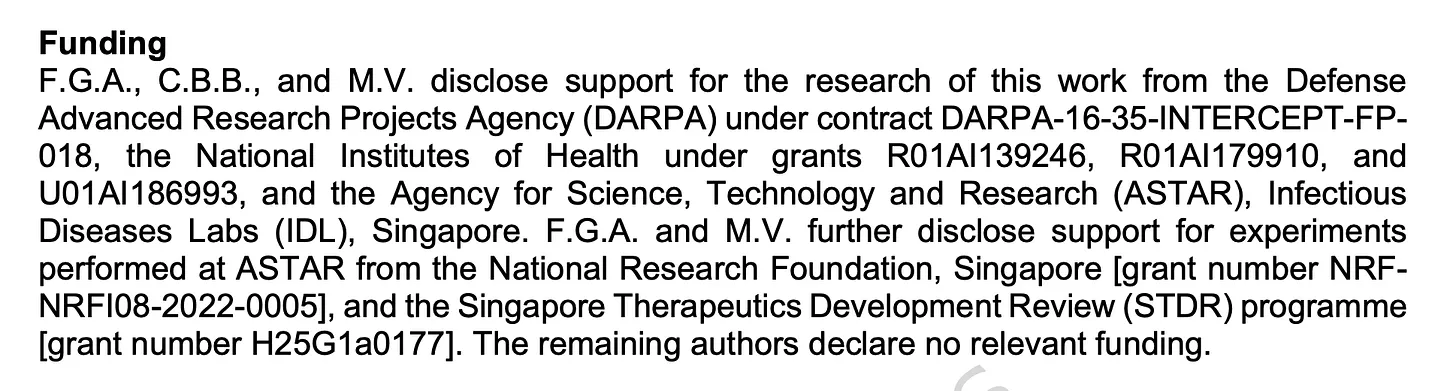
According to the funding disclosures, the work received support from the Defense Advanced Research Projects Agency (DARPA) under contract DARPA-16-35-INTERCEPT-FP-018 along with National Institutes of Health grants R01AI139246, R01AI179910, and U01AI186993.
The paper’s conclusion is perhaps the most revealing section.
Rather than presenting the findings as a purely academic observation, the authors state that the results “point towards actionable approaches for engineering interference-optimized DelVGs for therapeutic purposes.”
That statement is significant because it moves beyond observation and into engineering.
The researchers are not merely describing defective influenza genetics.
They are describing how defective influenza genetics gained enhanced replication, enhanced competitive fitness, and enhanced influenza-suppressing functions—and how those findings could be used to engineer optimized versions in the future.
From Defective to Gain-of-Function
The central finding is difficult to miss.
Scientists say they began with influenza-derived genetic elements that could not replicate independently.
They then produced versions with enhanced replication, enhanced interference potency, and enhanced competitive advantage.
The modified influenza elements became better at reproducing themselves and better at suppressing competing natural influenza viruses.
The experiments align with published gain-of-function (GOF) definitions.
According to a 2022 review published in Advances in Applied Microbiology:
“Gain-of-Function research on viruses is enhancing transmissibility, virus replication, virulence, host range, immune evasion or drug and vaccine resistance to get insights into the viral mechanisms, to create and analyze animal models, to accelerate drug and vaccine development and to improve pandemic preparedness.”
For critics of GOF-style pathogen research, the study raises an obvious question:
Why are U.S. military and health agencies funding experiments that transform defective influenza genetics into more replicative, influenza-suppressing biological systems?
Whatever one’s answer, the paper documents a clear before-and-after transformation.
The starting point was defective influenza genetics.
The endpoint was influenza genetics with enhanced replication and a stronger ability to suppress competing influenza viruses.
Follow us on Instagram @realjonfleetwood & Twitter/X @JonMFleetwood.
If you value this reporting, consider upgrading to a paid subscription.
For advertising & sponsorship opportunities, contact us by clicking below.


New 'Nature Communications' study shows U.S. military and health agencies bankroll GOF experiments giving flu stronger ability to multiply and to suppress competing natural influenza viruses. This Research should be ILLEGAL!
I don't think money is evil per se, but the willingness to take it at the expense of human life and wellbeing certainly is. Is there ANYONE in our govt that doesn't accept bribes/payoffs from pharma?! ANYONE???
On a related note, looking directly at him, I asked my new PCP if he got kickbacks/gifts/bribes of any kind from pharma sales reps or industry. Without looking up at me from what he was doing he said, unconvincingly, "No." I unapologetically told him, "I hope you don't mind if I don't believe you." I thought there would be some kind or response, something, but he didn't respond, and still didn't look up at me. That spoke volumes.