
HHS-Funded Experiments Create Bird Flu Pathogens with 'Mammalian-Adaptive' Mutations: bioRxiv Preprint
100% spread rate between mammals.

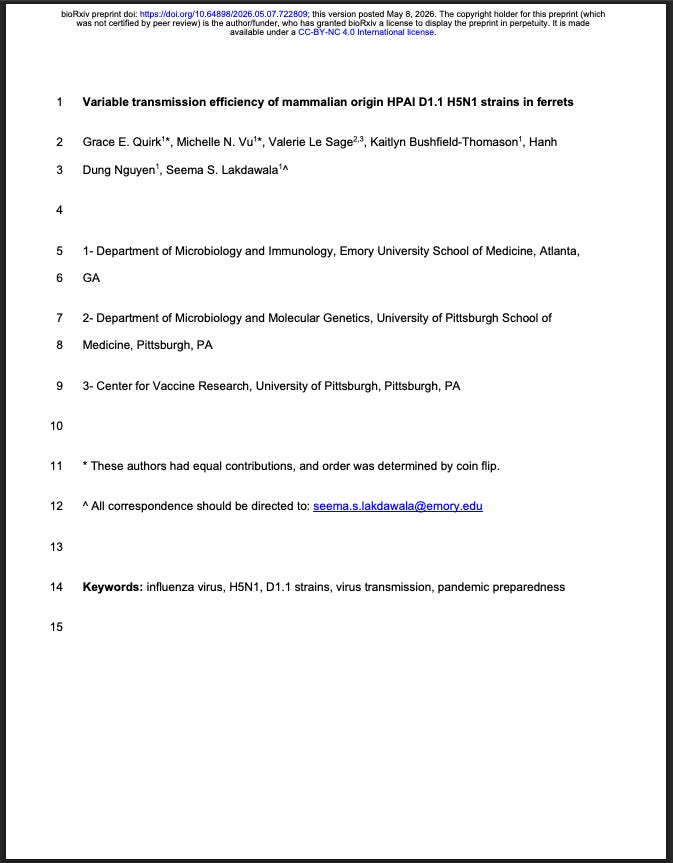
A newly released NIAID-funded preprint reveals that U.S. government-funded researchers claim to have created bird flu pathogens specifically selected for known “mammalian-adaptive” mutations, genetic changes said to help purported avian influenza viruses spread more efficiently in mammals.
The move comes amid unprecedented international influenza pandemic orchestration, covered extensively on this website.
The new study, published online ahead of print earlier this month, says one reconstructed human H5N1 strain virus transmitted between ferrets with 100% efficiency.
The study, titled “Variable transmission efficiency of mammalian origin HPAI D1.1 H5N1 strains in ferrets,” was conducted by researchers from Emory University, the University of Pittsburgh, and the Center for Vaccine Research.
You can contact NIAID here, NIH here, and HHS here to voice opposition to taxpayer-funded research on pandemic pathogens—particularly after Congress, the White House, the Department of Energy, the FBI, the CIA, and Germany’s Federal Intelligence Service (BND) all acknowledged that the deadly COVID-19 pandemic was “likely” the result of a laboratory incident involving engineered pathogens.

Follow us on Instagram @realjonfleetwood & Twitter/X @JonMFleetwood.
If you value this reporting, consider upgrading to a paid subscription.
For advertising & sponsorship opportunities, contact us by clicking below.
Researchers Specifically Chose Strains Carrying ‘Mammalian-Adaptive’ Mutations
The paper openly states that the viral strains were selected because they carried mutations associated with mammalian adaptation in the PB2 gene.
The researchers wrote:
“The three chosen strains contained several other mutations across all eight gene segments ... but were selected as representative strains with distinct PB2 mammalian adaptive mutations.”
Later, the paper reiterates:
“The viruses in this study were chosen because of their mammalian origin and their unique PB2 mammalian adaptive residues.”
In simple terms, “mammalian-adaptive” means the purported virus contains genetic changes believed to help it infect, replicate, or spread more efficiently in mammals instead of birds.
The paper specifically highlights the PB2 D701N mutation as a major concern. According to the study:
“PB2 D701N may increase the risk of onward transmission.”
The authors further warned:
“special attention should be paid to emergence of adaptation at the PB2 701 position.”
Researchers Synthesized Reverse-Genetics Systems From Digital Sequence Databases
The study then explains that the viruses were reconstructed in the laboratory using reverse genetics systems synthesized from sequence data deposited in GISAID.
According to the Methods section:
“Reverse genetics plasmids expressing A/WA/255/2024, A/Cat/TX/009022-007/2025, and A/NV/10/2025 were synthesized based on sequence deposited in GISAID.”
Meaning, the researchers did not simply observe naturally circulating viruses in the field.
They digitally obtained sequence data from the GISAID database, synthesized reverse-genetics plasmids corresponding to those sequences, and then rescued the viruses inside laboratory cells.
The paper further states:
“The eight reverse genetics plasmids were transfected into 293T cells...”
And:
“MDCK cells were monitored for cytopathic effect (CPE)...”
The experiments were conducted in BSL-3 facilities at Emory University and the University of Pittsburgh.
One Human H5N1 Strain Transmitted to 100% of Ferrets
One reconstructed strain in particular—A/NV/10/2025, a human isolate carrying the PB2 D701N mutation—produced the most alarming results in the study.
According to the paper:
“These results indicate robust (3/3, 100%) direct contact transmission of A/NV/10/2025 in ferrets.”
The paper also states that recipient ferrets infected through transmission developed severe disease:
“recipient ferrets naturally infected with A/NV/10/2025 reached humane endpoint criteria.”
That means the ferrets got sick enough that the protocol required euthanasia.
The study further reported:
“not only is this virus transmissible, but it can result in severe natural infection.”
Researchers Say the Mutation May Be Driving Transmission
The authors repeatedly linked the PB2 D701N mutation to the virus’s transmission efficiency.
The paper states:
“it is highly likely that mammalian adaptation of residue 701 is playing a role in the forward transmission potential of this strain.”
The study additionally notes that while only 1% of all D1.1 strains reportedly contain the PB2 D701N mutation, 7% of mammalian spillover cases contain it.
Meaning, according to the authors, this mutation appears disproportionately associated with mammalian infections.
NIAID, NIH, ARPA-H, & Blueprint Biosecurity Funding Confirmed
The paper confirms direct federal funding from NIAID and NIH.
According to the acknowledgements section:
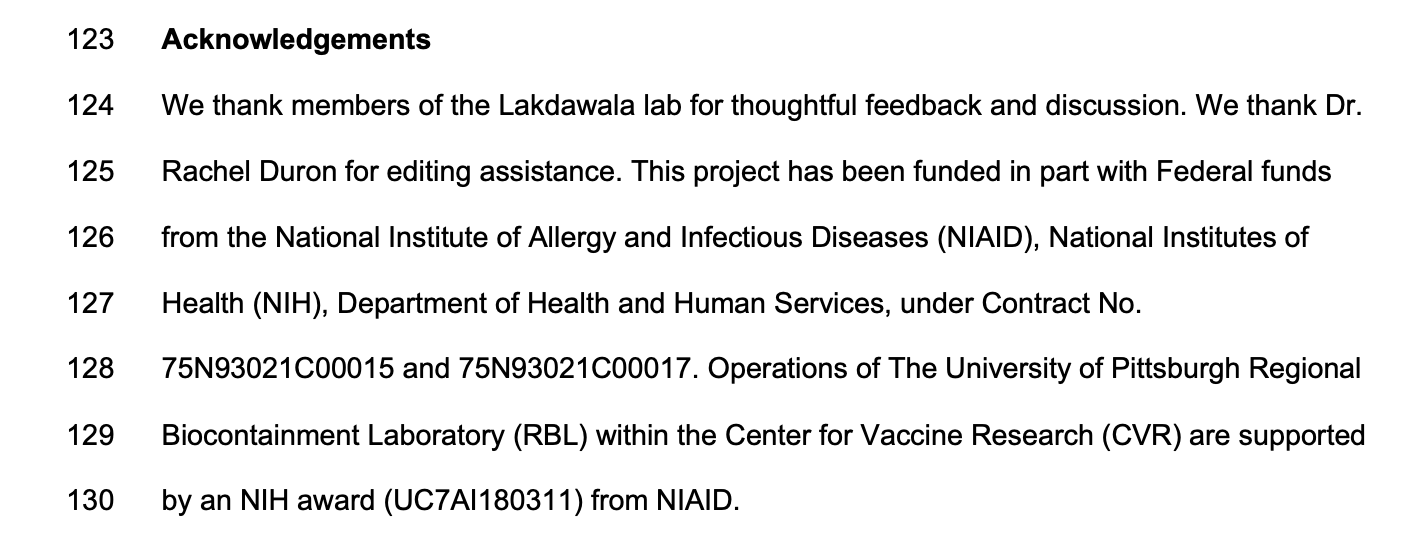
“This project has been funded in part with Federal funds from the National Institute of Allergy and Infectious Diseases (NIAID), National Institutes of Health (NIH)”
The authors also disclosed additional funding sources:
“The authors receive funding from NIH, Flu lab, Blueprint biosecurity, and ARPA-H.”
Bottom Line
The study raises renewed questions about why U.S. government-funded researchers are digitally reconstructing and experimentally testing bird flu strains specifically selected for mutations associated with mammalian adaptation and transmission potential.
The paper confirms that researchers synthesized reverse-genetics systems from database sequences, rescued the viruses in laboratory cells, and then tested whether those reconstructed strains could spread between mammals under controlled laboratory conditions.
One of those reconstructed human H5N1 strains carrying the PB2 D701N mutation went on to achieve “100%” direct-contact transmission between ferrets and caused severe disease in recipient animals after transmission.
Follow us on Instagram @realjonfleetwood & Twitter/X @JonMFleetwood.
If you value this reporting, consider upgrading to a paid subscription.
For advertising & sponsorship opportunities, contact us by clicking below.


you mean TAXPAYER FUNDED, don't you ? without our consent or approval as well...
The HHS gets it's funding from the people, it doesn't come out of thin air
So government is funding, and scientists are working hard to create something that is bad for us. What is the market for this??