

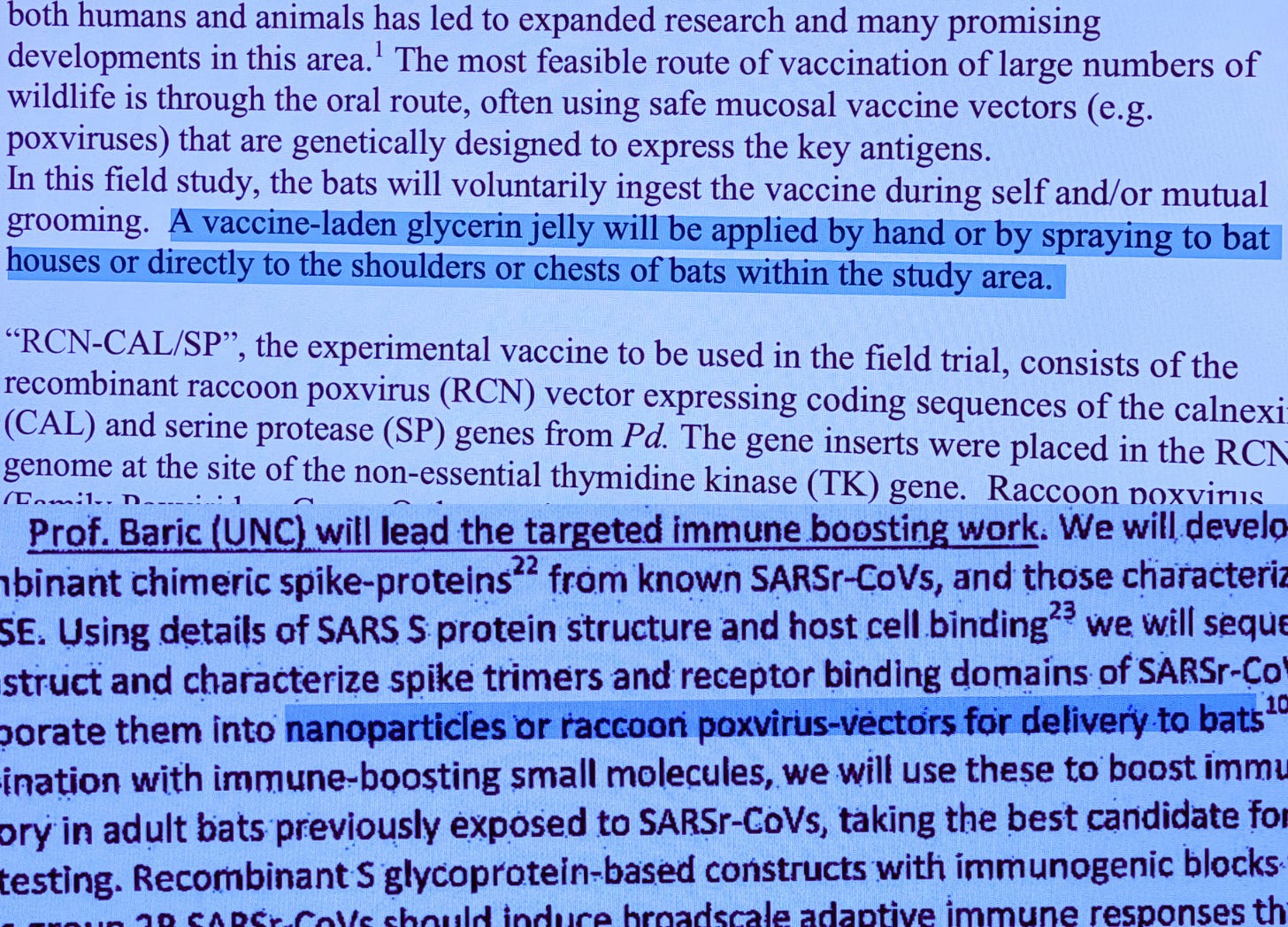
Months before COVID, the U.S. Department of Agriculture (USDA) documented plans to field-test an unlicensed experimental raccoon-poxvirus-vector bat vaccine that could be delivered “by spraying,” according to the agency’s July 2019 Environmental Assessment for Field Testing of a Pseudogymnoascus destructans Vaccine.
The USDA/APHIS assessment was issued under Trump Agriculture Secretary Sonny Perdue’s USDA and APHIS Administrator Kevin Shea.
The new findings come after this website recently revealed the U.S. government had funded PARC’s DEFUSE-linked biological mass-spray program during the COVID-19 pandemic (USAspending record 140G0220P0134).
In December 2024, this website was the first to piece together the evidence connecting DEFUSE to drone delivery, “self-spreading” vaccination (emphasized by Jim Haslam’s work), and “large-area inoculation of humans.”
Follow us on Instagram @realjonfleetwood & Twitter/X @JonMFleetwood.
If you value this reporting, consider upgrading to a paid subscription.
For advertising & sponsorship opportunities, contact us by clicking below.
The resurfaced 2019 USDA assessment states:
“A vaccine-laden glycerin jelly will be applied by hand or by spraying to bat houses or directly to the shoulders or chests of bats within the study area.”
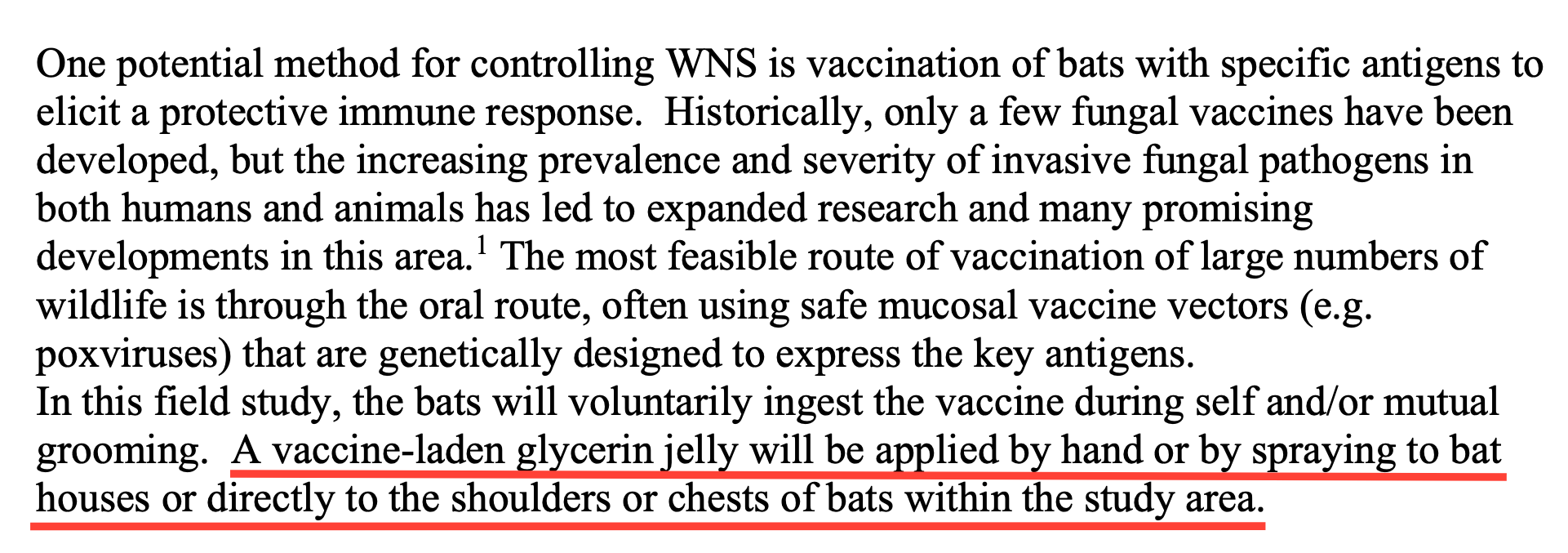


The DEFUSE connection is direct.
DEFUSE is the project submitted the year before the COVID-19 pandemic to the Defense Advanced Research Projects Agency (DARPA) that characterized a pandemic response to a future SARS-CoV-2-like outbreak.
DEFUSE itself discussed raccoon poxvirus vectors for delivery to bats, including incorporating proposed bat-vaccine material into:
“nanoparticles or raccoon poxvirus-vectors for delivery to bats”
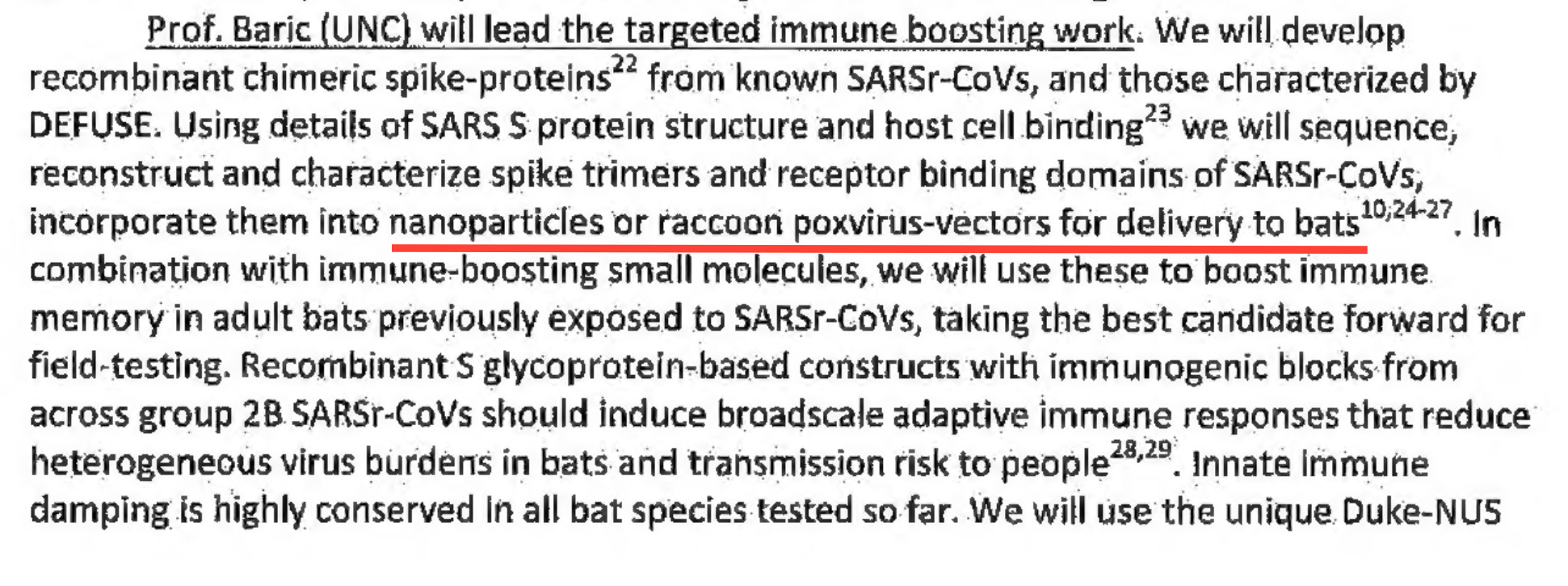
And the connection goes beyond using the same type of vaccine vector.
The U.S. Geological Survey’s (USGS) own DEFUSE task sheet explicitly joined those elements, calling for a poxvirus construct, a “glycerin jelly or other viscous substance” for delivering vectored vaccines, delivery methods developed “in conjunction with PARC,” and a “prototype system for automatic, mass delivery” to bats.
DEFUSE paired raccoon-poxvirus vaccine delivery with a self-distributing strategy in which vaccine-laden material placed on bats could be transferred to other bats through mutual grooming.
Its preliminary data also compared raccoon poxvirus with another poxvirus vector following oronasal administration to bats.
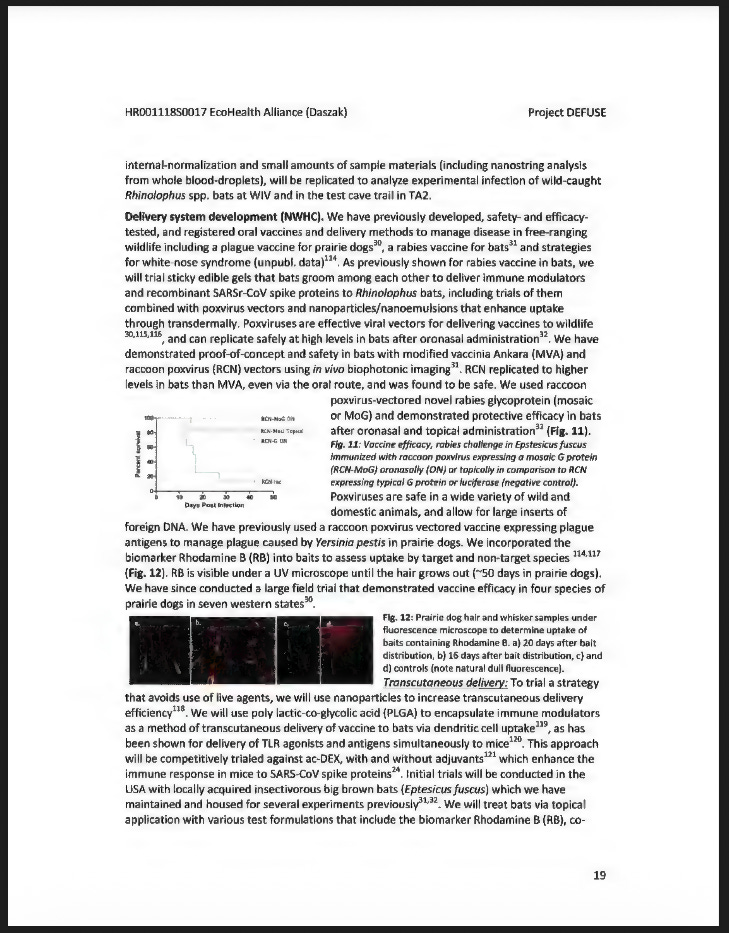
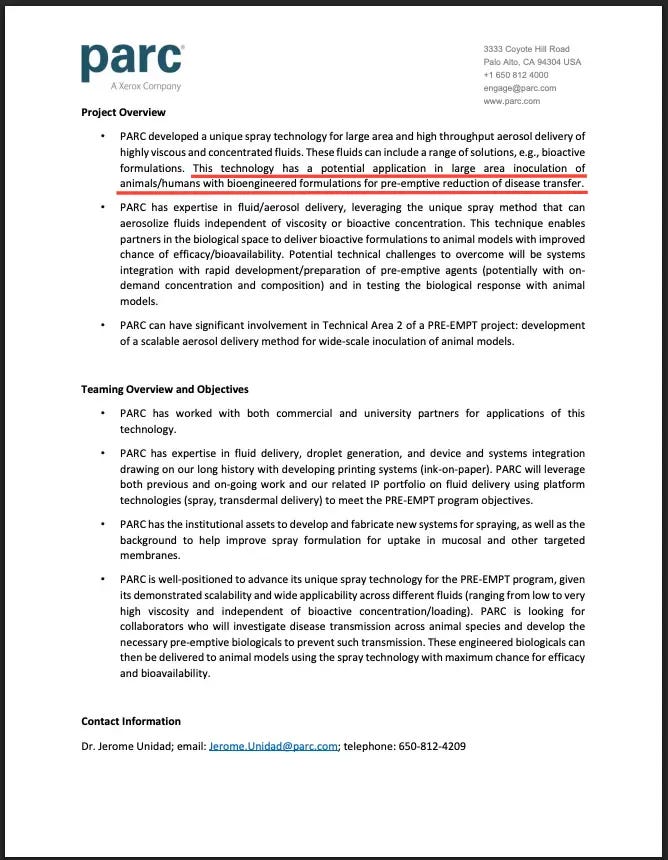
And the same research network proposed PARC aerosol technology capable of handling “Poxvirus formulations,” alongside language describing potential:
“large area inoculation of animals/humans with bioengineered formulations.”
The chronology requires only three premises.
1. USDA Approved Raccoon-Poxvirus Bat-Vaccine Spraying
The July 2019 USDA assessment concerned a USGS National Wildlife Health Center field trial.
USDA identified the experimental product as:
“Pseudogymnoascus destructans Vaccine, Live Raccoon Poxvirus Vector (RCN-CAL/SP)”
And authorized a field concept in which vaccine-laden material could be applied:
“by hand or by spraying”
Before COVID, a raccoon-poxvirus-vector bat vaccine had reached federal field testing with spraying as an expressly contemplated delivery method.
2. DEFUSE Proposed Raccoon Poxvirus, Self-Spreading, and Aerosol Delivery
DEFUSE separately proposed raccoon poxvirus vectors for delivery to bats.
Critically, DEFUSE paired raccoon-poxvirus vaccine delivery with a self-distributing strategy in which vaccine-laden material could be transferred among bats through mutual grooming.
That adds another layer to the delivery architecture.
The objective was not necessarily limited to reaching each animal directly.
The delivery concept was therefore not necessarily limited to individually treating every bat: material initially applied to some bats could be physically distributed to others through grooming.
DEFUSE’s delivery work also contemplated spray devices, including PARC aerosol technology capable of handling “Poxvirus formulations.”
The associated PARC material went further, describing:
“Potential application in large area inoculation of animals/humans with bioengineered formulations.”
That creates the documented continuity:
Raccoon-poxvirus bat vaccine → field spraying → DEFUSE raccoon-poxvirus delivery → vaccine transfer through mutual grooming → PARC aerosolization → potential “animals/humans” application.
The records do not require the USDA and DEFUSE constructs to be identical for that continuity to matter.
The shared platform, distribution concept, and delivery lineage are the finding.
3. APHIS Acknowledged Humans Could Be Exposed
The APHIS assessment did not say human contact with the experimental vaccine was impossible.
It explicitly contemplated it:
“Human exposure to vaccine-laden jelly on bats or objects is highly unlikely…”
That is an exposure pathway, not a declaration of zero exposure.
APHIS further stated:
“Human exposure will be limited to the qualified personnel handling the vaccine during distribution.”
Those personnel were required to wear latex gloves and N-95 respirators.
APHIS even described a potential consequence of direct contamination:
“Vaccine contamination through an abrasion in the skin or mouth, although unlikely, could result in a small localized blister.”
And the agency acknowledged:
“Although the safety of this experimental vaccine in humans has not been fully evaluated and, therefore, is unknown…”

APHIS therefore did not establish that humans could not encounter the experimental vaccine.
It acknowledged human exposure pathways while arguing that exposure would be limited and unlikely.
That distinction becomes especially consequential beside DEFUSE’s work on bat-to-bat transfer of vaccine-laden material and the later DEFUSE-linked language contemplating large-area inoculation with potential application to “animals/humans.”
Bottom Line
Before COVID, USDA approved field testing of a raccoon-poxvirus-vector bat vaccine that could be delivered “by spraying.”
APHIS acknowledged that humans could encounter vaccine-laden material on “bats or objects,” discussed contamination through the skin or mouth, and required handlers to wear N-95 respirators and gloves while acknowledging that human safety was “unknown.”
DEFUSE separately proposed raccoon poxvirus vectors for delivery to bats and a self-distributing strategy in which vaccine-laden material could pass among bats through mutual grooming.
Its delivery network also contemplated PARC aerosol technology capable of handling “Poxvirus formulations,” with potential application to “large area inoculation of animals/humans with bioengineered formulations.”
The forced inference is straightforward:
Before COVID, the government was already field-testing spray delivery of a raccoon-poxvirus bat-vaccine platform with acknowledged pathways for human exposure. DEFUSE separately proposed the same vector class for bats, vaccine distribution through mutual grooming, and scalable aerosol technology with stated potential application to “animals/humans.”
The questions now follow the physical system:
Where was it sprayed?
What poxvirus formulations went through the sprayers?
How far did PARC’s aerosol system advance? And what became of its stated potential application to “animals/humans”?
Follow us on Instagram @realjonfleetwood & Twitter/X @JonMFleetwood.
If you value this reporting, consider upgrading to a paid subscription.
For advertising & sponsorship opportunities, contact us by clicking below.


These people are maniacs. They need to be stopped.
Nothing they do is with the intent of protecting public health or even the health of animals.
What is it going to take?
I’m so sick sick of these monsters 👹